October 25, 2006
The Hidden Family by Charles Stross
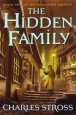 Second book in Stross's Merchant Princes series. In this volume, Miriam begins exploring another alternate world and opening it to commerce while in the other two known alternate Earths various and sundry plots thicken. Miriam continues to be hyper-competent (and hyper-lucky) to a degree that strains credulity. I suspect these books might be enjoyed more by people who are more Economics-geeky than I am. Still, Stross can spin a yarn interestingly enough to keep the pages flipping by. This volume has some nice character building for some of the minor women characters from the first book including quite a few interesting revelations about Miriam's foster mother.
October 22, 2006
Dzur by Steven Brust
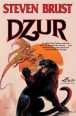 I can't think of another author who writes books that are as entertaining as Steven Brust's. Vlad Taltos, the protagonist of the series this is the tenth volume in, is a flawed, sarcastic, intelligent character who has had some significant growth over the course of the series while remaining fundamentally himself. This volume is lighter on plot than most of the books, but it makes up for it with a whole stack of in-jokes and a lovely framing device in the lush descriptions of a multi-course meal that start each of the seventeen (of course) chapters.
I should probably read it again cause I went pretty fast and by the end I completely couldn't understand why it was necessary for Vlad to enlist the assistance of Vera to get out of the fix he was in. Seemed like overkill.
But the book is fun and brings back some beloved characters and moves the story along. Definitely not the place to start, so catch up on the series before you hit this volume.
October 18, 2006
The Family Trade by Charles Stross
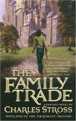 Miriam is a journalist reporting on corporate startups and venture capital. With the help of research assistant Paulette, she uncovers a massive money laundering operation. Rather than making her career, the discovery gets her fired and possibly stalked. If that weren't enough, her adoptive mother gives her a box of things relating to her birth mother. Among those things is a locket with a strange pattern inside. When Miriam examines it closely she finds herself abruptly transported from her cosy home in Boston to a cold dark wood.
In over her head in two worlds is about the size of it. But Stross's Miriam is a strong swimmer.
I was very distracted in the first few chapters when I wasn't sure whether the setting was England or New England. Mostly it seemed like the US, but there was just enough ambiguity ("Cambridge" doesn't narrow it down for example) and misplaced British terms to keep throwing me off. Also I think I was reading it too sporadically to get into the setting.
Miriam is one of those hyper-competent protagonists who are fun to read about but hard to believe. Fortunately Stross writes a tale with enough mysteries and a fast enough pace to distract you from the implausibility.
October 08, 2006
Frogs Into Princes by Richard Bandler and John Grinder
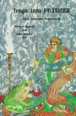 A friend of a friend suggested this as a good introduction to the field of Neuro-Linguistic Programming (NLP). The book is the transcript of a three-day seminar taught by the authors. The seminar was attended by mental health practitioners, so even apart from the content of the lectures, it's fascinating being a fly on the wall for such a gathering.
Bandler and Grinder call themselves modellers. They observe people who are successful in a domain and try to determine what it is that they're doing that makes them succeed. Once they figure that out they teach others how to use those methods. Seems like a good idea.
They're full of examples of ways in which the field of psychology/psychiatry fails badly in its supposed goal of making people happier and more effective members of society. As an alternative they lay out a system based on using the patient's sub-conscious mind to change their behavior. The methods are very close to hypnotism, but without most of the stereotypical baggage of that practice. There are no trances, they just talk to the patient, pay careful attention to the patient's conscious and unconscious reactions, and just tweak their psyche.
I haven't tried it, but I have friends who have had positive results from working with NLP practitioners. Seems pretty interesting. I might give it a try one of these days.
The book is out of print. I found a copy at the Seattle Public Library.
The Armies of Memory by John Barnes
 Don't go anywhere near this book unless you're caught up on the series. (A Million Open Doors, Earth Made of Glass, The Merchants of Souls) Earth Made of Glass especially has significant bearing on the events here.
The book starts off with spy/agitator/troubador Giraut Leones performing a concert in celebration of his 50th birthday, and nearly getting killed in the process. Many more assassination attempts follow. It seems like the plot moves along less in this volume than in the previous volumes. The dust jacket claims that this is the "Climactic Conclusion" of the series, but if so, it's a pretty unlikely conclusion if you ask me. But I never believe a word I read on a dust jacket anyway.
Iron Sunrise by Charles Stross
 Dang, I'm letting these go too long. Finished this some time back in August. It's connected to Singularity Sky, but not a sequel really, just some common characters who you'll recognize if you've read the previous book.
The main character is Wednesday, a 16-year-old goth girl who lives on a space station. Wednesday has a friend named Herman she has never seen. Herman speaks to her sometimes (through a communications implant if I remember correctly), and has taught her all sorts of useful skills mostly related to sneaking around the station without getting caught. As the book opens, the station is in the final stages of evacuation prior to the arrival of the wave front of the violent and unexpected explosion of a nearby(-ish several light years away) star. Wednesday isn't on the escape ship, instead she's still on the station running away from a robotic police dog set on capturing her. Why's she still on the station? Only Herman knows.
I can't remember too many of the details of the plot, but even if I could, they'd be spoilers and I wouldn't tell you. Wednesday basically continues on the run for the full length of the 400+ page book. She picks up some more enemies set on her destruction as well as a few allies in addition to the mysterious Herman. Most of the motive for all this is related to the fact that the exploding star didn't explode by accident, someone set it off.
It's a fun little espionage thriller.
September 28, 2006
Tigana by Guy Gavriel Kay
 Another flashback review. I finished this back in early August and gave my copy away so I can't check back.
The book starts out from the point of view of a young singer, part of a travelling company which has been chosen to perform the funeral rites for a monarch. During a break in the performance he follows one of his fellow performers when she leaves the group and suspiciously creeps through obscure passages in the palace. In this way, the young man finds out that some of his cohorts have ulterior motives. He also finds out that they will go to rather extreme measures to distract anyone from finding out what those motives are.
Later that night, he follows his newfound knowledge into a situation that shows that the conspiracy he has glimpsed is more subtle, more widespread, and more powerful than he could have suspected.
The gist (and this is kind of spoilery even though these revelations come in the first couple chapters) is that there are two competing wizards who are locked in a fragile balance of power over control of the various principalities of the region. The son of one of the wizards was killed in a battle to conquer a country. In revenge, the wizard erases the name of that country. No one who was not born there can hear the name spoken, or remembers that it ever was. All physical artifacts of the country's culture are summarily destroyed. The country is renamed as if it were a sub-region of another country, long its enemy.
Of course, the country's name is Tigana. The conspiracy the young singer has discovered is made up of citizens of that country and their goal is to get their homeland back. The rest of the book (and there's a lot of "rest", it's a doorstop, even in paperback) shows the course of their attempt.
It's a significant achievement to write a book of this complexity about such an unlikely conspiracy and have each twist and turn of the plot feel relatively realistic. It would have been easy for the thing to feel like it had been engineered rather than being an account of actual events in the lives of real people. While some of the events are awfully unlikely, Kay manages to show the people who participate in and precipitate these events in a way that made me believe them capable of the feats they are depicted as having achieved.
September 21, 2006
Darwin's Radio by Greg Bear
 I've got a big backlog of reviews to write. It's been over a month since I finished this book, and my copy of it stayed in the Philippines, so I can't cheat and look up the names and such. That's my excuse for the vague.
Archaeologist dude with a past (heh. He had trouble on a dig where he found cool stuff and tried to keep it away from the indigenous folks whose land it was on) is led to a cave in the Alps where the thoroughly frozen and well-preserved bodies of a man, a woman, and a child lie. They appear to be a transitional stage between cro-magnon and homo-sap (or whatever the right terms are). The couple that led him there disturb the site and on the way down the mountain there's an accident throwing everything into uncertainty.
Elsewhere, a biotech firm is foundering, while the wife of the founder is attempting to rustle up customers for their gene therapy in the former Soviet Union, and incidentally running across 50-year-old mass graves that seem to have resulted from an attempt to stop a plague that had something to do with pregnancy (the bodies of the women are pregnant, mothers, fetuses, and fathers were all killed before being interred.)
We soon find out that there's a virus going around that causes miscarriages.
And the rest of the book has our characters stumbling around trying to find out what the heck is going on.
Bear is a fine writer so the resulting book is readable, but it feels like the final solution came first and he then tried to figure out ways to keep his characters from figuring it out too soon. The result just felt too engineered to be real for me. There's a sequel which might be the book he wanted to get to, so I'll probably give it a chance.
July 11, 2006
Singer by Jean Thesman
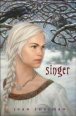 This was the last book I read for this year's Endeavour Award. I actually "read" a couple other books that didn't meet the criteria for writing them up here. I only post books that I read the whole book with no skimming. Some of the last few books (which shall remain nameless) were so clearly not contenders that I did some serious skimming so I could get on to the next one.
This book had its moments, but it came close to making me skim too. It's playing with a Welsh folk tale and there's a prologue that outlines the tale (in which a king's beautiful children are turned into swans by their evil step mother until another woman comes along to break the curse). The problem I had is that most of the events of the book tell the tale of the woman who broke the curse and while there are all kinds of portents and signs that presage the whole swan children episode, the story has nothing to do with the swan children until it's practically over. I think this could have worked, but the backstory Thesman puts together for her curse breaker just wasn't as engrossing as that brief summary of the fairy tale. And once the swan children do appear the telling of their tale really isn't much longer than the summary so there's no real payoff.
I guess I should have spoiler warnings on this stuff, but it just seemed like the book was self-spoiling, so I can't bring myself to care enough to bother.
June 15, 2006
The Gist Hunter & Other Stories by Matthew Hughes
 Picked this up to read from the pool for the Endeavour Award.
The stories are in three sections. The first section focuses on a character with the unlikely name of Henghis Hapthorn. Hapthorn is a discriminator, which is basically a private investigator. He is the self-proclaimed (and apparently otherwise acclaimed) best discriminator there is. Not sure why he had to be the best for the stories to work. Maybe just to account for the character's planet-sized ego. Each story poses a puzzle which Hapthorn solves with the sometimes help of his homebuilt computer and his buddy the demon from another dimension.
The second section follows Guth Bandar. Bandar is an aspiring noönaut, a navigator of the cultural subconcious which exists as an array of interconnected alternate realities each representing a historical Event, an archetypical Situation, or a basic setting or Landscape. These stories show how Bandar gets into (and out of) various tricky situations (of both capitalizations) in his quest to master the noönaut's trade.
The final section consists of a near handful of stand alone stories.
Most of the stories in the book appeared previously in some form (all but one of the Hapthorn stories, for example, appeared in The Magazine of Fantasy and Science Fiction). They all have a rather pleasing mix of fantasy and sf qualities (except the final story which is straight fiction and possibly my favorite of the bunch). Most of the stories were a bit over-written for my taste. A bit too much hooptedoodle, though it was executed well enough that it tended to fade into the background somewhat. Anyway, decent stories, but not really my thing.
June 12, 2006
Od Magic by Patricia A. McKillip
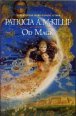 I think it was high school English class that instilled in me a skepticism about theme as an identifiable element of fiction. I was always of the opinion that it might be an emergent property of any sufficiently complex work, but felt that it was unlikely to be carefully engineered into any work I would want to read. This attitude makes me suspicious of any work where I feel like the there is an identifiable theme, moral, or lesson.
I say all that to explain my mixed feelings about Od Magic. The book is clearly about the costs of fear. How a population can be subdued by it, how it can incapacitate individuals, how it can corrupt those who wield it. It seems clear to me that this book was inspired by and serves as a commentary on the current US political environment. And the fact that I am in complete agreement with the points Ms. McKillip seems to be making with the book doesn't change the fact that I'm a little uncomfortable reading a novel that appears engineered to make those points.
And yet, despite the transparency of the motivation, McKillip, a master of her craft, has wrapped her message in a story that is actually interesting and peopled it with characters who are not cardboard cutouts. When I smacked my trepidation upside the head and locked it in the closet, I was left with a book that had me eagerly turning the pages to find out what happens next. Don't get me wrong, it's not a unique story (man is confronted by mysterious stranger who sends him to the city to a school for magic. It's been done to death, even by McKillip), but it's presented with enough twists and charming details to make it feel both fresh and timeless.
So my prejudices aside, here is a pleasant book with some relevant social commentary. What was I complaining about?
April 29, 2006
Fledgling by Octavia Butler
 Ms. Butler died in February of this year at the far-too-young age of 58. This was the last book she published. It's also the first book of hers that I've read.
This is one of those books that slowly reveals what's going on as the book progresses, so it's really hard to write a spoiler-free review.
It's told in first person narration by a young girl who awakens in a cave horribly wounded with no recollection of how she got there or who she is. Over the course of the first chapter she gets better (physically), and she gets better fast enough that you already are suspecting that there's something not quite human about her.
The events of the first two chapters are extremely shocking. The next few chapters reframe the shocking events to be less shocking. The shocking events are such that I expect to hear of attempts to ban this book by people who stopped reading at the shocking bits.
Ah hell, it doesn't spoil things too much to tell you that the narrator is a vampire. And that while that is shocking, it's not the most shocking thing in the first few chapters. And that Butler has tried to write a book with somewhat realistic vampires who could have inspired, but don't too closely match the common lore about vampires in our culture. Her vampires and their culture are fascinating and alluring.
I really enjoyed the first half of the book. The second half I enjoyed less, mostly because it strayed into the territory of courtroom drama which isn't my favorite. The ending made me sad, mostly because I'd grown to like these characters quite a lot and there won't be any more stories of them from Ms. Butler.
April 05, 2006
Runner by William C. Dietz
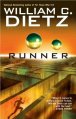 Runner is set in an almost post-technological far future. There was an interplanetary culture with frequent starship transit between planets. All that technology has been operating on automatic for a couple of centuries and it's starting to break down. The book follows Jak Rebo, a "runner" or courier. In the first chapter he is commissioned to deliver a young boy to a far-flung planet. The boy is thought to be the reincarnation of a religious leader. What complicates the task is that an opposing sect of the same religion has another boy that they think is the true reincarnation. Lanni Norr is a "sensitive", apparently a genetically modified human with psychic powers including the ability to communicate with the dead. She is in contact with a spirit who wants to bring back the technological era. She ends up joining Rebo and the boy.
The setting is really the most interesting part of this book. But not interesting enough to keep me from wanting to learn how to speed read so I could get through the thing in less time (I was reading it for the Endeavour Award screening process, otherwise I would have just stopped). The plotting feels very much like a role playing game campaign without much lattitude for player variations. Lots of plot coupons, lots of cardboard minor characters helping the main characters through their various trials. If it had been half as long it might have been tolerable, but at over 400 pages, it was just not enough story spread over too many pages. It's not really bad, I suspect there's an audience that will lap this up and beg for more (the end leaves plenty of room for sequels), but I'm not that audience.
March 20, 2006
Red Thunder by John Varley
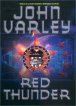 I've been a Varley fan for a long time, but his novels have always been hit or miss for me. This one is a hit. In a near future, a couple of space crazy late teens go joy riding on the beach with their girlfriends after watching America's first manned mission to Mars lift off. They narrowly avoid squishing a very drunk ex-astronaut and start a friendship with him and his eccentric genius cousin. Through the magic of some sufficiently advanced technology, some nationalistic fervor (a Chinese Mars mission is going to beat the Americans there), and a suspicion that the American mission's new drive technology has the potential to fail catastrophically, this unlikely group determines to build a space ship and head to Mars themselves.
The "teenagers build a spaceship" thing has been done repeatedly in the history of SF, but in my opinion never with as much credibility and humor as Varley pours into this tale. The characters are somewhat charicatured, but they do have personalities that make them feel real despite the cliches. Plus, the fun of having a semi-plausible wish fulfillment fantasy like this story going on pretty much swamps any such minor concerns. And it looks like the fun will continue as Red Lightning is slated to come out in April.
March 05, 2006
Night Train to Rigel by Timothy Zahn
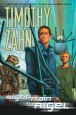 If I hadn't been reading this as a nominee for the Endeavour Award, I probably wouldn't have finished it. Frank Compton is the protagonist. He used to work for the UN, but he has a problem with politically ill-advised honesty and got fired. As the book opens he's being given a train ticket by a guy who's close to dead from some kind of sci-fi projectile weapon. Compton doesn't know anything about why the guy's there or why he's being given this ticket, so of course he goes and gets on the train. But it's not a choo choo, it's an FTL conveyance with a stop out by Saturn that ties the inhabited systems of the galaxy together. Once he gets out there he finds out it's the "spiders" who run the railway who've given him the ticket cause they have a job for him. They have had a prescient vision of a big war and want him to stop it before it starts.
I have a lot of gripes with the book, but they all boil down to the fact that the author's hand is far too evident for my taste. Compton gets shuffled around by different players in the story for reasons that while they aren't completely arbitrary are pretty close to "Zahn says so". The capabilities of technology are arbitrarily limited or expanded to move the plot along too. I could go on, but I'd rather just put this one behind me. Okay, one more: it's twice as long as it needs to be. Read something else.
February 27, 2006
Inside Job by Connie Willis
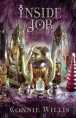 Short novella (90 pages) in a pricey hardcover package ($35)(hooray for the library!). Rob is a professional skeptic, debunking psychics and other charlatans who con the faithful out of their money. His partner in debunkery is Kildy, a beautiful movie starlet who quit the business to follow Rob's calling. Kildy wants Rob to investigate a channeler whose act has recently gotten intriguingly more authentic. When they go to the "seminar" they see the usual channeler mumbo jumbo until half-way through when the channeler abruptly changes personality and starts berating the audience as fools and rubes.
The story plays out with a lovely sense of cognitive dissonance as the debunkers try to determine where the truth lies with a channeler who seems to be trying to debunk herself. The confusion is echoed in Rob and Kildy's relationship where skepticism is standing in the way of truth. It's a fun little story.
February 12, 2006
End In Fire by Syne Mitchell
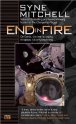 It's 2022. Claire Logan is an astronaut about to return home to her husband and their four-year-old son when China sets off a high-altitude nuclear blast in its war with India over one of Earth's last oil fields. That's just the first in a cascading series of Really Bad Things that happen to Earth and/or Claire in the course of the novel.
Mitchell does a really great job of balancing the need for lots of exposition and detail with that for a page-turning peril-filled plot. I'm not one of those SF readers who pulls out his slide rule and double-checks the orbital mechanics of a story, but short of that level of verisimiltude, I felt transported into the microgravity environment of low Earth orbit. I was impressed by how she even used the fundamental gravity contrast as a way to distinguish the planet-side scenes. It's cool how just having a character set down a cup of coffee can seem so alien when you just came out of a scene where great pains had to be taken to keep discarded items from wreaking havoc in microgravity. One of the short films from last week's film festival pointed out just how hard it is to get this kind of stuff right. It was called Microgravity and was set in a similar space station locale to this book. For a low-budget short film it did an amazing job, but there are too many details that remind you that it was filmed in a gravity well. Little things like a seat back flexing every time the actress settled back from reaching for a control just took me out of the movie. Granted, Mitchell is working in a different medium, but she got this stuff right.
I had a little bit of a problem with suspending my disbelief through the series of unfortunate events. I think there were just too many things that went just wrong enough to be scary and force the characters to move on to the next thing, but not wrong enough to be total disasters (for the main characters. Plenty of the events were total disasters for minor characters and for large swaths of mankind). So, yes, I'm simultaneously complaining that there were too many successive awful things, and that the awful things weren't awful enough.
Whining aside, I plowed through the book in short order and, despite the depressing subject matter, enjoyed it.
February 07, 2006
The Murdering of My Years by Mickey Z.
 Subtitled "Artists and Activists Making Ends Meet", the author sent out questionnaires to 22 people whose life work is in activism or art, and asked them how they keep it together financially. The people range from 64 to 22 years old at time of publication and are all over the map in almost every other measurable demographic. The book is structured with a section of bios of the various respondents followed by sections for each question with attributed excerpts from responses to that question. The questions are about current financial situation, jobs held, work experiences, selling out, ideal work situation, impact of decision to be artist/activist on various aspects of life, inspirations, resources, and advice.
I don't think I'd say that I learned anything from the book, but it was interesting to read through all the answers. There aren't a lot of commonalities with this diverse crowd of people. I was struck by how mundane their work experiences are for the most part. Temps, McJobs, and other typical "unskilled" labor was the most common work background. The other things that seemed to be common were debt, parental support, and just plain getting by on not much money.
When they were talking about their chosen life goals, however, the tone was completely different. Passionate expressions of determination, excitement, and pleasure abounded.
I think I would have enjoyed reading the book a lot more if it hadn't been chopped up by question. I'd like to have been able to get more of a sense of the individuals, and it was almost impossible for me to do that when I was getting only a paragraph or two of any one person at a time.
I'd strongly recommend this book to anyone (especially anyone still in college) who's considering an idealistic life path. It probably won't dissuade you (not that it should), but it gives a starkly honest picture of what that choice can mean as it relates to work and money.
Almost forgot, the title is from Charles Bukowski who said, "I always resented all the years, the hours, the minutes I gave them as a working stiff. It actually hurt my head, my insides, it made me dizzy and a bit crazy. I couldn't understand the murdering of my years."
January 25, 2006
Freakonomics by Steven D. Levitt and Stephen J. Dubner
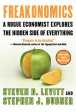 I had a gajillion different people tell me that I had to read this book. And it's certainly got interesting bits. If you're one of the few people who hasn't read the book or heard the hype, Leavitt is a relatively young and brilliant economist whose most visible skill is in asking interesting questions and then using available data to find out the real answers. Questions highlighted in the book include "Why do drug dealers still live with their moms?" and "Where have all the criminals gone?"
I enjoyed the book, but there were parts of it that bugged me. The main annoyance was the way that they posed questions, gave the actual answers and then told the exciting story of finding the answers. I just would have found the story much more exciting if the answer hadn't been revealed beforehand. I suppose some of the answers were so non-intuitive that I was supposed to disbelieve them until they proved them to me, but I'm really good at suspension of disbelief and read pretty much every book as if it were gospel truth (at least in the context of the book.) My other gripe is that there's really very little of an arc to the book. To their credit they warned me right up front that there wasn't going to be one. But there was kind of a half-hearted arc in that there were principles highlighted at different points that kind of felt like they might fit together in an overall theme, but didn't. I think I would have preferred it if the book had been a series of completely standalone essays.
Okay, I'm kind of being grumpy here. The book really is very interesting and brings out a lot of cool counter-intuitive results through the application of the science of economics. If you don't understand the difference between correlation and causality before you start you should have a pretty good grasp by the time you're done. Plus you'll know what some school teachers have in common with some sumo wrestlers.
January 16, 2006
The Straight Girl's Guide to Sleeping With Chicks by Jen Sincero
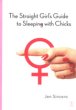 I love living in a world where this book exists. I love living in a world where sex-positive stores like Blowfish can carry it. I love living in a world where I was able to check it out of my local public library so I could easily indulge my curiosity.
In that spirit of personal freedom, how about if I put the rest of this review behind a cut so anyone who might be offended can exercise their right to change the channel before I get to the (mildly) naughty bits.
The book is exactly what you'd expect from the title. Sincero starts off explaining why a straight woman might choose to have a sexual relationship with another woman:
- the potential fluidity of role changes when both partners have the same equipment and sensibility
- the ability to keep going (and going) past climax
- the fun of simultaneously imagining what you're doing being done to you
- girls are soft and feel good
- getting to do something that makes you feel kinky
I found myself laughing out loud several times at Sincero's irreverent wit. And at the pictures. The section on positions is illustrated with photos of a pair of tattooed Barbie-style dolls.
As a straight guy who regularly sleeps with a chick, and shares all but a couple pieces of equipment with the people this book is aimed at, I expect to be able to put at least some of what I read to good use.
January 11, 2006
Kris Longknife: Defiant by Mike Shepherd
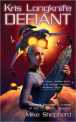 I've been calling this a military science fiction weepie. Kris Longknife is the daughter of a wealthy political family. Rather than follow the wealth-building arm of the family or the political arm, she joined the Marines. Rather than being a good little soldier she specializes in solving problems by using her natural leadership skills (and some supernaturally competent sidekicks) to foil bad guys' plots through insubordination and out-of-the-box thinking. She's kind of like Miles Vorkosigan, only without the physical handicaps. The book sees her first on a brief diplomatic misson that turns into a hostage rescue. This part of the book didn't have any connection to the later plot that I can recall. It could be that it was wrapping up some issues from one of the previous books (this is the third book in a series, but the first I've read), but it felt like a stand-alone story. Then in the rest of the book she takes command of a meager planetary defense force in an effort to repel a well-armed fleet of invading starships. So there's the military and science fiction parts of the story. The weepie part comes in because in the course of the battle all sorts of people make all sorts of personal sacrifices in an almost certainly doomed attempt to defend their home from the bad guys.
The book is written and paced well enough that it's easy to keep turning the pages, but the plot and setting felt unduly contrived to me. People follow Kris, but it's not clear why. The majority of the book is the leadup and execution of a single intricate battle scene and it was clear almost from the beginning what the outcome would be, at least to this jaded reader. It is a series, after all. A series I probably won't read any more volumes from. (And I only read this one cause I'm scoring books for the Endeavour Award again this year.)
January 08, 2006
jeffy's 2005 in books
Perhaps a better preposition would be "out of". By my count I finished a whopping 36 books in 2005. I believe this is the fewest books finished by quite a lot since I started keeping track in 1992. I suspect it's the fewest books finished in any year since I got my first library card.
I can't decide which was the worse culprit in this pathetic showing: time spent reading blogs and other stuff on the internet, or time spent watching tv shows on DVD. I'm not prepared to give up either of these activities altogether, but clearly a better balance must be found.
Might have to trim the blogroll a bit. I currently have 190 feeds. This week I kept track, and 110 of those feeds updated for a total of about 1200 entries. That's just one week! Normally I try to read everything dry each day so I don't notice the sheer volume of material I've been going through.
Probably should cut back a smidge on the TV show DVDs too. We've been watching Buffy and Angel regularly and in 2005 watched full seasons of Firefly and West Wing and Joan of Arcadia and Battlestar Galactica and Sex and the City (done with SatC finally). We've got seasons of Seinfeld sitting around and Northern Exposure will come from the library soon.
I'm less begrudging of the time spent watching movies. I'll summarize our year in film in another post.
January 01, 2006
Shaman's Crossing by Robin Hobb
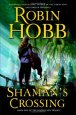 With this volume, Robin Hobb has graduated to that exalted sphere of authors whose names appear on the dust jackets of their books in larger type than the title (at least on my collection of US hard covers... Can't speak for when or whether this happened for other editions of her books.) This makes me happy because at least for now it means that her books are selling and so there are likely to be more of them. It also gives me hope that we may see the books written under her previous nom de plume, Megan Lindholm, reissued, which would be a very fine thing.
Shaman's Crossing is the first book in a new trilogy. It doesn't appear to be set in the same world as Hobb's previous books, but I wouldn't discard the possibility that they might be somehow linked. The setting finds an early industrial society which has almost completely subjugated a nomadic horse-riding, plains-dwelling, earth-worshipping people, and is starting to encroach on a forest-dwelling people of similar culture. The parallels to the North American conflicts between the First Nations peoples and the white man are blatant, but not precise.
The story is told in first person from the point of view of Nevare Burvelle, the son of a Gernian soldier recently promoted into landed nobility by the king following the long, bloody war with the plains people which, in turn followed a longer, bloodier war with the country of Varnia which lost Gernia their entire coastal holdings. Not a happy political climate. The culture dictates that birth order of the sons of the family strictly dictates the life pursuits of each son. The first-born is the heir, second, a soldier, third into the priesthood, fourth, the arts, etc. Nevare is a second son and so trains from his youth to be a soldier.
The first half of the book follows Nevare's early training, first with his father and a series of hired tutors, then, less conventionally, with a plainsman enemy of his father's who subjects Nevare to trials his father didn't bargain on.
The second half of the book follows Nevare to the Cavalla (read Cavalry) academy.
For much of the book I felt like I had a pretty good idea of the shape the story was going to take. This being the first book, it's not clear that I was completely wrong, but I was definitely surprised by the way this volume played out. I can't be more specific without major spoilers. I was a little disappointed by the second half of the book in that large swaths of it are fairly generic boarding school drama, but Nevare's unique personal challenges, the secondary characters, and the details of the world made it just novel enough to keep me going through all the boilerplate. Next volume should be interesting.
Raven's Strike by Patricia Briggs
 I read this book's predecessor, Raven's Shadow when I was scoring books for the 2005 Endeavour Award. It was one of my favorites of those books so when this second volume showed up on the "Choice Reads" shelf at the library, I checked it out.
Again in this volume I really enjoyed the central characters, all members of one family. The fantasy setting is the other major attraction, with a well-realized system of magic where different people are born into certain fairly tightly defined magic ability flavors, each symbolized by a bird. Meadowlark for Healer, Cormorant: weather witch, Owl: bard, Eagle: guardian, Falcon: hunter, and Raven: mage. The family conveniently has members of all the orders but the healer Lark. It's also something of a mystery since not everyone is born into an order and a single family with such a concentration of order-bearers is virtually unprecedented.
The plot of Raven's Strike reveals big chunks of the world's backstory in the bounds of a fairly generic stop-the-big-bad storyline. What makes it fun are the characters, the nature of the world, and Briggs's page-turner pacing.
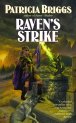
This volume is also distinctive for having cover art with one of the most annoyingly wrong depictions of a character from its book. The model for the woman on the cover appears to be about sixteen years old and is wearing some sort of ridiculous faux-medieval livery with flowing sleeves, a short skirt, and some kind of cape. The character who actually participated in the scene depicted is a mature, practical mother of three who wouldn't be caught dead in such an absurd costume.
The Sky Road by Ken MacLeod
 See if we can finish up the reviews for 2005 here. This story is told in two timelines. The first is far in the future following a major global disaster where Clovis, a history graduate student, meets a woman, Merrial, while he's working a summer job building the first spaceship to be launched following the disaster. Merrial is a "tinker," a member of the small subculture that still mucks about with computer technology and software. The second timeline is before the disaster and follows Myra Godwin-Davidova, the People's Commissar for Social Policy, Prime Minister Pro-Tem, and acting President of the International Scientific and Technical Workers' Republic, an entity existing somewhere in the vicinity of Kazakhstan.
The two threads are connected, of course, but how exactly is not revealed until mid-way through the book. I really liked the Clovis and Merrial thread from the beginning, but had a hard time getting traction with the Myra thread until the connection became clear (the connection wasn't really a surprise, but there was enough ambiguity about it that I didn't want to make any assumptions). MacLeod does a wonderful job of writing characters with realistic grey areas. It's not always clear who's acting in good faith. The characters themselves have to muddle through with best guesses about each other's motives. Reading a book where this is true points out how rarely books are written this way. It seems a much more interesting and honest way to tell stories about humans to me.
This book is the fourth in MacLeod's Fall Revolution series. I didn't read them in order, and it doesn't seem to be necessary to do so. I can see that rereading them in different orders is likely to throw different characters and parts of the narrative history into the spotlight. And they're worth rereading both for the characters and the fascinating future history MacLeod put together.
November 24, 2005
Between the Strokes of Night by Charles Sheffield
 Nancy Kress wrote a trilogy (Beggars in Spain (1991), Beggars and Choosers (1994), Beggars Ride (1996)) about what happened when the need to sleep was genetically engineered out of the human genome. In her books, one of the side effects of sleeplessness was drastically extended lifespan.
Sheffield's book, published in 1985, has sleep researchers discover a mode of human physiological function in which need for sleep is drastically reduced while lifespan is even more drastically increased.
It's so cool how effectively these SF tropes can be reused and reformed. Sheffield's book and Kress's trilogy really have very little in common except for the vague details outlined above.
First and foremost, Sheffield's mechanism is much less plausible. They find that by chilling the human body to near freezing (accompanied by some hand waving techie tech additional assistance), they reach a new slowed-down mode where they can operate in a way that seems normal to them but is slowed down 2000 times from "normal" function. I can think of a dozen reasons why this isn't very likely, but who cares.
What Sheffield does with the idea is to tell a story where interstellar travel with sub-lightspeed ships is plausible. You've got to choose your implausibility, you know?
He carves out an entertaining story exploring the implications of this change.
It's interesting that Ursula K. Le Guin wrote a story in her Changing Planes about a world where engineering away the need for sleep transformed the changed people into simple beasts with no trace of humanity. Was this a curmudgeonly commentary on the wishful thinking of Sheffield's and Kress's techno-utopian imagining?
Sunshine by Robin McKinley
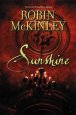 Both Becky and Rachel raved about this so it was a pretty good bet that it'd be good. Of course Robin McKinley wrote it so the odds are even better.
There are some books where half-way through the first chapter you know everything you need to know about the characters and the setting, and then there are the books that slowly unfold, revealing details as they become important to the story so that the world and characters come into progressively sharper focus as the book goes on. Sunshine is a book of the latter sort. And as such, it's very diifficult to write a spoiler-free review because almost anything I could tell you about it is a mystery as the book begins. I'm probably not spoiling too much by saying that it takes place in a world where vampires and werewolves and other demons and monsters are an accepted true part of life.
In such a setting there's a lot of information that has to be communicated to the reader so they know, for example, what sorts of demons there are. McKinley uses a clever device to make these info-dumps palatable: she puts them in the narrator's voice where the narrator, the Sunshine of the title, is a bit of an Other nerd, spending her spare time reading all about the Others. Her voice as someone who knows a little bit too much about her preferred subject is completely convincing and charming enough, in that way that true-geeks always are, that the info-dumps are virtually transparent within the larger narrative.
I don't want to say anything more about it because you should just go and read it for yourself. Go.
November 22, 2005
Serenity: the Official Visual Companion by Joss Whedon
 Okay, so I'm a shameless fanboy. This book consists of the shooting script for the movie Serenity packaged with an extended interview with Joss Whedon and some pre-production documents also written by Whedon. Oh and a whole bunch of pictures from the movie and the production process. It's probably exactly the same stuff that's going to show up as extras on the DVD when that comes out in a few weeks. But when I saw it in the book store my brain went "Shiny!" and handed over the bucks.
On first watching we were pretty disappointed in the movie. We were in the process of watching the series DVDs for the third or fourth time and so we were completely steeped in the characters and the worlds as they were in the show. They changed for the movie in subtle but important ways and to us it was just wrong. After we saw the movie a couple more times the new slant became more tolerable and we could accept the movie on its own terms.
Reading the script makes it clear that the changes were definitely engineered in by Whedon and weren't a strange byproduct of the production process. There is stuff in the script that was cut from the theatrical release too so we're hoping there will be some deleted scenes on the DVD. Inara in particular got cut pretty heavily.
The pre-production memos from Whedon trying to give the production crew a sense of the Firefly universe are fun to read for Joss's self-deprecating yet goofily pompous tone.
It's a nicely put together little book of fan goodies.
November 20, 2005
Changing Planes by Ursula K. Le Guin
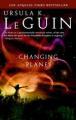 The conceit of this book is that the period of loose-endedness one has while waiting in an airport for one's connecting flight, far from being boring wasted time, puts one in a position to (literally) visit other planes of existence. The book is made up of 16 short pieces describing different planes visited by the narrator through the auspices of the Interplanary Agency which mediates and facilitates travel between the various planes. Each entry is part travelogue and part fable, using the strange ways of living on these other worlds to examine the variety of ways in which thinking beings can relate to their environments and each other.
I could reduce many of the planes to a brief description (the plane where no one speaks aloud, the warrior plane, the plane where never sleeping was a very bad idea), but condensing Le Guin is not a satisfying activity. She is an author who has more original thoughts before breakfast than I have in a week, and a facility with prose that is unmatched. I have a hard time being reasonable about Le Guin. She is a true master.
That said, I had a hard time getting through the book. I think I've had it out from the library for three months. This almost surely has more to do with my state of mind than any failings of the book. I did plow through the last third in a few hours on vacation last week. I was just flipping through the first couple of chapters before writing this entry, and I can't see what could have been holding me up, so probably just mood. If you're the sort of person who likes Le Guin, then this is the sort of thing you will like.
Anansi Boys by Neil Gaiman
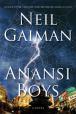 Fat Charlie Nancy discovers at his father's funeral that said father was Anansi, the trickster god in spider form. Fat Charlie also learns at the funeral that he has a brother, Spider, he has never known. Fat Charlie invites his brother for a visit and his life is never the same.
Fat Charlie is a pretty typical Gaiman protagonist, an everyman who's not prepared to find the supernatural becoming a part of his everyday life. So when Spider comes along and starts passing for Fat Charlie (first with his boss, and then with his fiance), Fat Charlie goes to some unthinkable lengths to get his life back.
The book is very light in tone. While some fairly awful things happen to some of the characters, they're not the sorts of things liable to give you nightmares. Fat Charlie and Spider are both likable in their own ways and concern for each of them keeps some level of suspense rolling even in the face of a story that seems assured of a happy ending from the beginning. Fun quick read.
September 09, 2005
Creating 3-D Animation by Peter Lord and Brian Sibley
 I was looking at the photography section in the library and the subtitle of this bright yellow book caught my eye: "The Aardman Book of Filmmaking". I pulled it down and sure enough, Wallace and Gromit grace the cover in all their toothy plasticine glory. It's a neat book. It starts off with an extensive illustrated history of stop-action animation from the early days of Edward Muybridge's motion studies up through George Pal and Ray Harryhausen and all the rest. There are lots of names covered from all around the world showing that animation isn't just Disney. And if the various denizens of the Aardman studios get a bit more coverage than anyone else, well, they did write the book, after all.
The rest of the book has purely practical chapters about basic equipment, simple technique, modelmaking, set design, animation and performance, and finally putting it all together to make a film. Each chapter is generously illustrated with examples from Aardman films and these illustrations make the book worthwhile reading even if you have no intention of doing your own animation. It's a fascinating glimpse behind the scenes of their wonderful films, mostly the Wallace and Gromit shows, but also the earlier stuff and a couple of peeks at Chicken Run which was in production as the book was being written. But even if you have no intention of doing your own animation going in, you'll surely be tempted by the time you finish.
The emphasis is, predictably, on film and model stop-action work. Even so, there's enough stuff in here about animation in general that any aspiring animator is sure to pick up a few useful tips.
September 05, 2005
Darwin's Blade by Dan Simmons
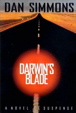 I thought I kept a pretty close watch on Dan Simmons's production, but this book slipped right by me until a friendly librarian recommended it last week. I might have missed it because Simmons is genre shifting again. This book is a straight crime drama thriller, not horror, not science fiction.
Protagonist Darwin Minor is an independent accident reconstruction expert. His job is to figure out what chain of events resulted in the aftermath that's usually all anyone sees of a fatal accident. Early on in the book, someone tries to kill him for reasons he can't fathom. It quickly becomes clear that the murder attempt is connected to an ongoing investigation of a suspicious series of botched insurance fraud attempts. And the rest is the mystery so I'll just shut up.
The book is written in a really interesting voice. It's third person, not first, but the things being told are all the things that Minor would notice.
The book is very tightly plotted and I'd be astonished if the film rights aren't a hot property. It's got car chase gun fights, explosions, snipers, elaborate car crashes, snappy dialogue, a little gratuitous sex, a sweet love story, and a glider vs. helicopter dog fight. What's not to love? I'd pay 8 bucks to see it in the theatre. Great fun.
September 04, 2005
The Year's Best Science Fiction and Fantasy for Teens (2005) ed. by Jane Yolen and Patrick Nielsen Hayden
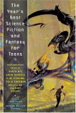 If you step back and think about it, fiction is an amazing thing in and of itself. It's a little boggling that abstract symbols can be processed through your eyes to assemble a virtual reality in your brain that can seem nearly as real as anything in the outside world. I find that short fiction accentuates this effect much as the first bite of a sinful dessert is often the most intense and satisfying part of the experience.
Nielsen Hayden and Yolen have assembled a whole trolley full of intense experiences in this new (first annual) collection of speculative fiction short stories with maximum teen-appeal.
The first story is "The Faery Handbag" by Kelly Link which tells about a young woman's relationship with her grandmother and the grandmother's curious relationship with her possibly enchanted handbag.
"Blood Wolf" by S. M. Stirling is set in the world of some of Stirling's novels, an alternate history Earth where Nantucket island is sent back in time to the Bronze Age. The title character is a young, we might say "savage", viking man coming to seek his fortune in the new world.
Lynette Aspey's "Sleeping Dragons" is set in Australia and told from the point of view of a young girl whose human-seeming brother hatched from an egg.
"Endings" by Garth Nix is an ambiguous short-short about joy and sorrow.
David Gerrold wrote "Dancer in the Dark", one of the longer entries. In it, something bad has happened to the world and a refugee boy is transported to a small farming community in the American midwest to work for his keep in the strangely dark world of its denizens. As much as I agreed with the message of this story I found its metaphor a bit too transparent (no pun intended) for it to work well as a story.
"A Piece of Flesh" is by Adam Stemple who I know as the excellent guitarist of Boiled in Lead (he's also the son of Jane Yolen who disclaims having been the one to choose his story for this collection). The story is of a young girl who is the only one who notices that her little brother has been kidnapped and replaced with a changeling.
Delia Sherman contributes "Catnyp", a fun little urban fantasy set in the New York Public Library. Sort of.
The collection starts a tradition of including one story from the early days of the genre, and in this volume that story is "They" by Rudyard Kipling (published in 1904), a sort of ghost story that is as mysterious today for its unaccustomed style and setting as for its subject matter.
"The Wings of Meister Wilhelm" by Theodora Goss is set in North Carolina after the Civil War when a violin-playing German appears in town and captures the imagination of a rebellious young woman.
"Displaced Persons" by Leah Bobet tells what happened to the Wicked Witch's flying monkeys after she died. From the monkeys' point of view.
Finally, Bradley Denton's "Sergeant Chip" is told from the point of view of an intelligence-enhanced army dog explaining how and why he came to kill eighteen soldiers in defense of the people in his care.
It's a very good collection of stories, just as you'd expect from editorial superstars like Yolen and Nielsen Hayden. They accentuate each story with brief sensitive introductions along with suggestions for other books with similar subject and tone to each story. I look forward to next year's edition.
September 02, 2005
Digital Photography Hacks by Derrick Story
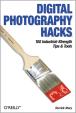 I bought my first O'Reilly & Associates book in 1986 at the bookstore on the Cal State Stanislaus campus where I was a Math/CS undergrad. It was a book about Usenet and I still have it, though I haven't used a news reader in close to a decade (unless you count the web interface at http://groups.google.com/, which I suppose you should now that I think about it). O'Reilly titles were always written for geeks by geeks, and this current volume is proof that they still are.
This is not a reference manual, and it's not a "how to take pictures" tutorial. It is just what the subtitle declares: "100 Industrial-Strength Tips & Tools". They're a wild variety of tips. How to take pictures of a white board. How to take soft focus portraits with a panty hose filter. How to take pictures of fireworks or little kids or the moon. Useful things to do with a camera phone. Common photoshop touch up operations. And lots of other stuff. You can look at the Table of Contents for yourself. I won't use every single one of these hacks, but a majority of them sound like fun to try and a bunch more are things it's good to know exist in case I'm ever in a situation to need them (like the existence of a camera mount that clamps to a partially rolled-down car window, or how to take my own passport pictures) so I will be buying a copy of this to add to my multitude of O'Reilly titles.
Something From the Nightside by Simon R. Green
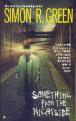 The setting of this book is so nearly identical to that of Neil Gaiman's Neverwhere (published in 1998 after the Gaiman-scripted BBC miniseries from 1996. Green's book is copyright 2003.) that I had a hard time not trying to fit Neverwhere into this book as backstory. It doesn't really work, though since the flavors of the two works are so different. Gaiman's is creepy in that humorous, insidious, fey way he does so well. Green's is more mean and malevolently dangerous.
For those who have read neither book and don't know what I'm on about, Nightside is about a private investigator, John Taylor, who gets a job that takes him back to the "Nightside", a place he has left behind and is reluctant to revisit. The nightside is a sort of parallel version of London existing alongside and within the one we know. Taylor is complete cliche wisecracking private detective and the style is verging on parody of the hard boiled noir trope. Green does okay making the style and voice of the book work on those terms, but the story feels rushed and arbitrary. The book's very clearly a setup for a series, but I didn't find the characters engaging enough to make me want to read farther. They got into sticky situations and then got out again through their special powers. They had relationships, but they didn't have any chemistry. In a similar way, the plot didn't feel like a story that was happening to people, it felt like a clumsily devised role playing game. Not my cup of tea.
August 20, 2005
Harry Potter and the Half-Blood Prince by J. K. Rowling
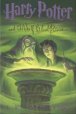 Read this the weekend after it came out (I was second in line to read Rachel's copy). The good news is that this is a far better book than the previous volume, almost completely lacking Order of the Phoenix's extreme case of logorrhea. Not to say it's not a weighty tome, but it doesn't go on and on and on to no purpose like the last book.
As the penultimate book in the series, it has a major case of middle-book syndrome, though. You can see Rowling moving everything into place to set up for the formidable task of wrapping up the story that's become a cultural phenomenon for a generation of kids. Unfortunately, it sure looks as if volume seven is going to be a "collect the plot coupons" story. Maybe she'll surprise me.
The best thing about the books has been the core characters of Harry, Ron, and Hermione. Rowling has done a great job of growing them up. I especially enjoyed this book's treatment of their sexual awakenings. I really liked the way she portrayed Harry's inner hormonal turmoil.
I won't share any speculations about the implications of the book's ending. I've got some theories, but I'm perfectly happy to wait for the last book to see what happens.
Let Your Life Speak by Parker J. Palmer
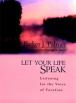 This is a tiny little book (110 small pages) subtitled "listening for the voice of vocation". It was being used for a study in a mid-life spirituality group a few of our friends are in. We joined in. I don't do well with reading books a chapter at a time for a meeting. I tend to put it off until the last minute and then read the chapter even more quickly than usual and then go to the study, and then put the book down until it's time to cram for the next one. But while my appreciation of the book was hindered by this format, I did like what I read and will probably read it again some time.
The book is a collection of essays on various topics orbiting around the idea of vocation where "vocation" is close to Frederick Buechner's wonderful definition: the work that you most need to do that the world most needs to have done. The book concentrates mostly on the first half of that equation. Palmer tells about his own personal journey toward his vocation and in the process helps illuminate a common path that can lead us to our own most appropriate destination. Palmer is a Quaker, so the book is written with a religious bent, but it's a quiet and thoughtful religiosity that I think few could find offensive.
One of the most interesting parts of the book is Palmer's description of the process he used to make a difficult vocational decision. It's a Quaker practice called a "clearness committee" where Palmer assembled half a dozen of his most trusted friends for a three hour meeting. Rather than giving him advice, their job was to ask him honest, open questions aimed at helping him discover his own inner truth. The process was simultaneously excruciating and liberating as his friends helped him to cut through the bullshit stories he had been telling himself and get to the truth that was a little too scary to face on his own.
It's this sense of thoughtful honesty that makes the book so engaging. Plus you've got to like someone who can write these sentences: "Years ago, someone told me that humility is central to the spiritual life. That made sense to me: I was proud to think of myself as humble!"
August 16, 2005
Now, Discover Your Strengths by Marcus Buckingham and Donald O. Clifton, Ph.D.
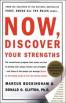 My boss's boss made him read this book. Then my boss offered his team the opportunity to have their very own copy. Predictably, when offered a free book I said, "sure, why not."
The basic premise of the book is that all the usual self improvement focus on repairing one's weaknesses is wrongheaded. The authors contend that your weaknesses are part of your nature and while they can be mitigated, they're not going away. Instead, they posit that one is better served by identifying one's strengths and honing them to a razor edge and applying them as appropriately as one can to life's challenges.
This all begs the question of what your strengths might be. The Gallup organization who are behind this book have analyzed the data from studies of over two million people and distilled them down to a set of 34 strengths. Not only that, they've devised a questionairre which will tell them what your top five strengths are. You'd think that when you (or your boss) pay $30 for a cheesy management book, the questionairre would be included in the purchase price and you'd be right. Sort of. Printed on the inside of the dust jacket of the book is a code number you can use to take the test exactly once at the gallup web site. Whatever. It's not my money. So I took the test and, lo, my five biggest strengths are apparently:
input, intellection, ideation, adaptability, and relator
Of course to find out what those really mean you have to read the sections expanding on their meaning in the book. There are some vague sketch explanations on the web page, but they're only marginally better than the words alone.
None of their findings comes as a particular shock to me, but they are interesting. I was disappointed to learn that the book doesn't focus much on the honing part of the equation, but more on a management view. It talks about how you should relate to and deploy an employee who posesses a particular strength. I guess this would be useful if I were or wanted to be a manager, but since I'm not and don't, not so much.
It's a quick read, but I wouldn't recommend you spring for the book/test unless your boss will pay for it.
The Phoenix Guards by Steven Brust (repeat)
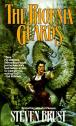 After reading all those books that were slightly outside of my comfort zone, I wanted to read something that was pure fun. Brust's first Dumas pastiche fit the bill perfectly. The exaggeratedly florid style of this book and the ones that follow after just make me giggle with glee. And the book bears rereading very well. With all the twists and turns of allegiance and fortune, it's virtually impossible to remember the whole book with enough clarity to ruin all of the surprises. Great fun.
August 06, 2005
Raven's Shadow by Patricia Briggs
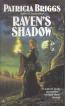 The last Endeavour Award candidate I read for this year's award. And happily it was my favorite of the bunch. There ought to be a name for the flavor of fantasy this is. It's not epic exactly, there are no great quests or overwhelming evils or superhuman heroes or mystical beasts. The characters are all recognizably human with plausible talents and failings. The magic is subtle and inherent, not overly ritualized or attached to ancient artifacts.
The first chapter introduces Tier, who's returning home from a campaign as a soldier in the army. Along the way, he rescues Seraph (though there's some ambiguity about that. Her attackers may have thanked him had they known more about her). The remainder of the book takes up close to twenty years later, Tier and Seraph have been married nearly as long and have three teen-aged children. You could pitch the flavor of the story from here as The Incredibles in a medieval setting, but that's only a hint. In short, Tier disappears and the rest of the family sets out to rescue him. The details make it a gripping tale. Briggs introduces characters with abandon and each is complex and nuanced and interesting. In the end there's plenty of room for sequels, and I for one would be happy to read another book in this setting with these characters.
Dreams of the Desert Wind by Kurt R. A. Giambastiani
 Another candidate for the Endeavour Award, and the only one I really had to struggle to get through. I wanted to like it. The subtitle is "A modern fantasy of the Middle East" and that sounds like a great concept. But the book is too rough to deliver on the promise. The plot is driven by coincidence. The characters are cardboard cliche cutouts, the American student, the Israeli girlfriend, the shifty Arabic guide, the wise Bedouin patriarch.
And yet I can't condemn it completely, the prose was readable if a touch precious, and the pacing was good. I think with a firm editorial hand and a rewrite or two this could have been a good book, but it just isn't there yet.
July 31, 2005
Very Bad Deaths by Spider Robinson
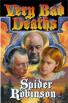 Another Endeavour contestant, though I'd already bought a copy so I would have read this one anyway.
Spider Robinson has been stuck in sort of a rut for 20 years, but it's a rut that I like. Almost all of his books depict lovable misfits who save the world through luck (often bad), hard work, inspiration, and getting psychic. The threat changes, but the pattern of figuring out the solution doesn't vary in flavor all that much. In Very Bad Deaths, the threat is from the king of all psychopaths who's got a nasty plan that must be foiled. The foilers are an aging suicidal newspaper columnist, his college friend nicknamed "Smelly" who has discovered the plot (through means which are a spoiler despite the fact that the jacket copy describes them in detail. Don't read the jacket copy! Of any book. At least until you're done with the book.), and a woman they enlist who's a cop.
What makes Spider's books fun, though, is the outrageous details he weaves into these tall tales, and the way he makes it seem reasonable that real-seeming people make intuitive leaps that belong in a Heinlein novel. If you like Spider's stuff you'll like this book. If you haven't read him before you might like this book if a humorous SF thriller sounds like fun. If you're one of the many people who got tired of Spider's schtick a long time ago, it's not safe to come back yet. As I'm in the first group, I had a ball reading this book.
The Secrets of Jin-Shei by Alma Alexander
 Third book I read for the Endeavour Award. This one was refreshing for being a stand-alone novel. It's set in a fictional land modelled on Imperial China. The story revolves around a number of women whose connection is the "jin-shei" of the title, a sort of formalized friendship bond.
I really enjoyed the book. The characters, while not all likable, were all interesting and had plausible and sympathetic arcs. The book covers nearly the entire lives of the different women with their various interlocking relationships. The magic in the book wasn't typical fantasy magic and was used consistently and responsibly (no "good thing I know the spell to save the day!" deus ex magica cop outs). My only quibble is that it could have been 100 pages shorter without sustaining too much harm. The overall effect is sort of Divine Secrets of the Ya-Ya Sisterhood in Imperial China. Worth reading if that sounds at all appealing to you.
July 30, 2005
Dragon and Soldier by Timothy Zahn
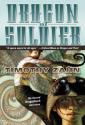 This is the second book I read for the Endeavour Award. It's the second book of an open-ended series about young Jack Morgan who in the first book (Dragon and Thief which I have not read) seems to have teamed up with a K'da named Draycos. The K'da are aliens with two modes of operation. They look like what we'd call a dragon when operating autonomously, but have to spend some portion of their time attached to a host in which mode they appear two-dimensional, almost like a tattoo on the host's body. Jack is an extremely independent though somewhat amoral (in the sense that he's been operating as a con man with his (now deceased, though still around as an AI) uncle for most of his life) fourteen-year-old while Draycos is an adult "Warrior Poet" who follows a strict moral code.
I enjoyed the premise that I've just laid out, and the characters were well enough drawn that it was fun getting to know them better through the course of the book. The plotting left something to be desired, though, with the whole rationale of the events in the book feeling contrived. Maybe I was just missing something from not having read the first book.
July 18, 2005
Consequences by Kristine Kathryn Rusch
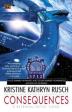 Back in early May I heard that the Endeavour Award was looking for readers. The Endeavour is an award given for a work of speculative fiction published by a writer from the Pacific Northwest. The process for the award requires that each eligible nominated book be read by five or seven preliminary readers who each rate the book in a number of different categories. These ratings get distilled down to a numerical score which is used to trim the field down to a half-dozen finalist books which are then judged by a panel of three professional writers. I signed up to be a preliminary reader, so this and the next several book reviews are of books I might not necessarily have chosen on my own, but were read closely for a good cause.
Consequences is part of Rusch's "Retrieval Artist" series. It appears to be the third volume in the series, but I was able to keep up pretty well despite not having read the prior volumes. The book is a hard-boiled detective story set in a city on our moon. Miles Flint is an ex-cop turned retrieval artist, which is an occupation that takes some explaining. The setting is a future where we've made contact with multiple alien species. In such a diverse cultural mix, humans can run afoul of obscure alien laws. If humans think the law is unjust or the penalty too severe or something, the offender can go into a kind of witness relocation program where they're disappeared off to some obscure corner of the galaxy to hide and wait hoping to outlive the statute of limitations or the race they've offended. Retrieval artists are sort of reverse bounty hunters who track down a disappeared person when it's safe for them to come back to their old lives.
Flint's case in this book gets mixed up with a murder for which he feels some degree of responsibility, so he tries to solve the case bringing him into conflict with his old partner, Noelle DeRicci. To complicate matters, the investigation happens in parallel with a summit meeting between some warring races. As the story unfolds, we find out that this confluence of events is not exactly a coincidence.
All the interlocking events in the book have a nice feeling of realistic complexity, and not everything ties together cleanly. There are some reasonable coincidences and some reasonable random events that make the overall plot feel more like real life than a styilized story. And if some of the plot uncomfortably brings to mind some of our real world current events, I can forgive Ms. Rusch since she went to reasonable pains to keep things from being too parallel.
June 26, 2005
Debt-Proof Living by Mary Hunt
 Someone on the 43 Folders mailing list mentioned this book with an executive summary that turned out to be the main thing that stuck with me from reading the book.
Here it is: First, kill off all your unsecured debt. Done? Good. Now out of every paycheck, put 10% off the top in savings, give away another 10%, and then live on the remaining 80%. By way of managing that 80%, set up a "contingency fund" to bail you out in the event of a major catastrophe (lose your job, that kind of thing), and then through monthly contributions, build a "freedom account' which buffers all your recurring, but non-monthly expenses so that the money's there when you need it (for insurance premiums, tax bills, christmas presents, whatever).
None of this is rocket science, but it is spelled out here in one place where you can see it long enough to get it into your brain (if your brain, like mine, isn't very good at holding on to such concepts). There's a bunch more stuff delving in to more of the nitty gritty details of living a debt-proof life. The book is no Your Money or Your Life (Dominguez & Robin's deservedly classic financial management book), but it was a good refresher for me.
June 23, 2005
Dark As Day by Charles Sheffield
 The cover declares this as "a sequel to Cold As Ice". I suppose this is true in the loose sense of historical continuity (plus one common character), but there's hardly any plot continuity between the two books. Not that there's a problem with that, just me getting annoyed with misleading cover copy. Usually I avoid reading any of the words on the jackets, but that bit keeps getting its barbs into my brain.
Dark as Day follows the pattern of the other two books in this setting having bunches of seemingly unconnected characters slowly converging towards an exciting conclusion. This one includes threads about historically predictive computer models, reception of alien transmissions, a plot to destroy all life in the solar system, and other fun stuff like that. The characters and their individual sub-plots are more distinctive and engaging than in Cold as Ice making this book fun. I lost my suspension of disbelief late in the book when a lot of the action depended on some extremely smart people behaving in an uncharacteristically dense way, but it wasn't enough to ruin the book, just enough to pull me out of it for a moment. Overall, an enjoyable future solar system book.
April 16, 2005
What You Can Change and What You Can't by Martin E. P. Seligman, Ph.D.
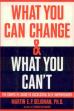 Someone on the 43Folders list mentioned this book so I got it from the library. Seligman is a professor of psychology. In this book he synthesizes the extant research on various common psychological issues and presents the results in lay language.
What I found refreshing about the book was Seligman's candor about his own qualifications and biases. He is meticulous about tagging statements which are his own opinion or theory vs. what the studies have shown. He also is very careful to qualify the results of the studies with his opinion of how well the experiment was designed. It's a very science-based approach.
The issues he considers in depth are things like anxiety, panic, phobias, obsessions, depression, anger, post-traumatic stress, sex issues (from transsexuality to homosexuality to more mundane sexual issues), dieting, alcohol and other substance abuses. In each case he considers what is known or theorized about the causes of the issue. From there he moves on to the various treatment options and what is known about their success rate both in the short term and long term.
The results, as the title implies, range from maladies like panic where the causes and solutions are well understood to things like weight loss where there does not appear to be any such certainty. If you suffer from any of the issues in the last paragraph, I would urge you to take a look at this book to help you decide how (and whether) to pursue treatment.
All that positive stuff said, Seligman falls into the usual trap of medical research. If 75% of the participants in a study of a treatment are not helped then that treatment is judged a failure. And yet 25% of the people were helped. To me, this is the more interesting part of the result. What was it about the interaction of that 25% with the treatment in question that made it work for them and not for the others? We are all different in uncountable ways, and it seems to me that progress in medicine isn't going to make any giant leaps until they accept that fact and start tailoring treatment to the individual patient.
Back off my soapbox, the book is a fascinating read and my copy is bristling with flags on interesting passages. A few examples...
About anxiety, he writes.
Everyday anxiety level is not a category to which psychologists have devoted a great deal of attention. The vast bulk of work on emotion is about "disorders"--helping "abnormal" people to lead "normal" emotional lives. In my view, not nearly enough serious science has been done to improve the emotional life of normal people--to help them lead better emotional lives. This task has been left by default to preachers, profiteers, advice columnists, and charismatic hucksters on talk shows. This is a gross mistake, and I believe that one of the obligations of qualified psychologists is to help members of the general public try to make rational decisions about improving their emotional lives.
About nature vs. nurture (genetic vs. environmental influences being dominant in psychological matters)
And make no mistake about the political side. It is no coincidence that Locke fathered both the idea that all knowledge is associations and the idea that all men are created equal. The behaviorists, scientific Lockeans all, dominated academic psychology from the end of World War I to the Vietnam era. John Watson began the behaviorist movement in the era of the melting pot. His popularity was in part the result of his covert message: The new immigrants were not inferior to the people already in America; they could be molded into the same high-quality stuff that the WASPs already were. The defeat of Hitler added fuel to American environmentalism: The genocide of the concentration camps filled my generation with determination never again to countenance genetic explanations of human psychology.
and
Some of what is difficult to change ties us to the life-and-death struggles of our ancestors. And it is not only our fears that are prepared. The sexual objects that we spend our lives pursuing, the aggression and competition we have such difficulty suppressing, our prejudice against people who look different from us, our masculinity or femininity, and those recurring obsessions we can't get out of our minds are all examples of psychological links to our biological past.
The last forty pages of the book are foot notes, and they're worth reading as well, not only because of the links to the studies Seligman cites, but also because some of the funniest parts of the book are in the notes.
What is needed now is an updated edition to include any new findings since this book's publication way back in 1993.
April 11, 2005
Cold As Ice by Charles Sheffield
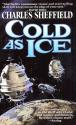 This is one of the books that I discovered was connected to The Ganymede Club after I finished that book. Fortunately, it turns out the connection is pretty loose. Cold As Ice was published before Ganymede but takes place after. They have one character in common, but there's no dependency of understanding between the two books. Not to say the books aren't similar. They are. Very. And not. This one starts off with a ship at the end of the Great War (the interplanetary one, not our puny WWI) trying (in vain) to evade a smart weapon set on destroying them. The ship manages to send the children in their crew away in escape pods with little hope that they will be recovered in time to survive. The rest of the book takes place many years later and introduces a bunch of different characters who seem to be completely unconnected until they all start to collide and interact in interesting ways that all converge on Jupiter's moon, Europa. There's lots of fun sci fi stuff along the way (a very very very large array telescope (elements accross the entire inner solar system), submarine exploration of the oceans of Europa (and Earth), human genetic engineering) and the characters are engaging enough to make you want to find out what happens to them. It's a fun read and I'll keep working through Sheffield's stuff.
March 19, 2005
Hybrids by Robert J. Sawyer
 Third book in Sawyer's Neanderthal Parallax series. True to form, Sawyer crams enough ideas into this one book for a whole career for any other author. Topics investigated include the potential of genetic engineering, trans-cranial magnetic stimulation and the origins of religion in the so-called "god organ," the effects of testosterone, the effect of pervasive surveillance on crime, the origin of consciousness, rapid repolarization of the Earth's magnetic field. Add to all that cool science-based skiffy stuff some interesting characters and a nifty trans-dimensional (and credulity straining) setting and Sawyer's workmanlike prose and you have a fun series of books to read. In this one Sawyer pokes a few more holes in the Neanderthal society making it seem a little less utopian. I felt like he took some liberties with the actions of his main characters causing them to do things they wouldn't have done except under authorial fiat. Still, the book is entertaining and there is almost certainly another one coming down the line in this series judging from the open loops at the end of this one.
New Magics ed. by Patrick Nielsen Hayden
 Shortly after reading Patrick Nielsen Hayden's excellent New Skies I found out somehow that he had edited a similar volume of young adult stories leaning more toward the fantasy end of the sf spectrum. It's been a while now since I read it, but I like having more time between read and review for short story anthologies.
Neil Gaiman leads off the collection with "Chivalry" which has a fabulous first sentence: "Mrs. Whitaker found the Holy Grail; it was under a fur coat." Gaiman delivers nicely on that setup.
I'd already read Ellen Kushner's "Charis" in one of Terri Windling's Borderland books. It's a great distillation of the coming of age story uniquely suited to the Borderland setting where Faerie intrudes into modern midwest North America.
"Jo's Hair" by Susan Palwick, as the title implies follows Jo March's hair from the point where she cut it all off in Little Women through the life of adventure and non-conformism that Jo herself could have lived had she not chosen the path she did.
In "Not All Wolves," Harry Turtledove examines human bigotry through the eyes of a young werewolf in 12th century Cologne.
Debra Doyle and James D. Macdonald contribute "Stealing God," a hard boiled mystery with a Knight Templar protagonist.
"Mama Gone" is Jane Yolen's story of a young girl who has to cope with the fact that her recently deceased mother is a vampire. And she manages to write it without ever once bringing to mind Buffy. Well, maybe once.
Charles de Lint's "The Bone Woman" is another I'd read before. It's set in his fictional city of Newford, and is about the people on the fringes of life in any big city.
"Liza and the Crazy Water Man" by Andy Duncan appeared previously in Nielsen Hayden's Starlight 1. It was nice to read it again here, especially with the resurgence in interest in old time music following the Coen Brothers' Oh Brother, Where Art Thou?. The fantasy element of the story is pretty subtle in this one.
Sherwood Smith looks at stories like The Lion, the Witch, and the Wardrobe and Pamela Dean's Secret Country books from the point of view of the parents of the children who find their way into another world in "Mom and Dad at the Home Front".
Emma Bull writes "A Bird That Whistles" which I could have sworn was in Ellen Kushner's Horns of Elfland, but isn't, so it must have been Double Feature where I read it first. A winsome story of the collision between magic, music, and growing up.
"The Bones of the Earth" is one of Ursula K. le Guin's recent stories returning to the world and characters of The Wizard of Earthsea. I can't write about le Guin without gushing.
The book ends with Orson Scott Card's "Hatrack River" which tells the story of the birth of Alvin Maker. I have been annoyed by some of Card's stories, but there is no arguing that he is a brilliant craftsman of characters and prose. This story had tears running down my face from sadness and joy. How does he do that?
As usual, Patrick Nielsen Hayden delivers the good stuff.
February 26, 2005
Happy Baby by Stephen Elliott
 I checked this out of the library after reading a brief interview with the author in the Powell's bookstore newsletter. The book seems to be semi autobiographical, telling a series of stories from the point of view of a man named Theo who grew up in foster care in Chicago. The stories are in very nearly reverse chronological order, showing Theo as an adult and then moving farther back into his past as the book goes on.
The thing that caught my eye in the Powells interview was the author saying that it was a book about S&M, and then going on to talk mostly about the book's style of writing. I've enjoyed some other books that could be discussed in similar terms. It's not my kink, but there's something about pain play and humiliation play that speaks eloquently of the human condition.
And Elliott speaks eloquently indeed. There's not much flash in the writing in this book, but he manages to perform that magic that puts you behind the eyes of a character despite having characters with whom I have almost no experience in common. I often say this about books that I enjoy, but in this case it's especially true: the characters and situations seemed real to me. With this kind of material it would be easy to slip into caricature and to stylize the events into being more palatable to a general audience. Instead, Elliott keeps things raw, seeming to tell the stories the way they happened or at least the way the characters saw them.
All that said, the book's probably not for everyone. Some of the sex and violence content is consensual, but some is decidedly not. Caveat lector.
February 17, 2005
The Ganymede Club by Charles Sheffield
 I'd never read Sheffield before, but I found myself in the Twice Sold Tales on University with half an hour to kill before my bus home, and a hankering for some good sci fi. This one looked like it would fit the bill, and did, keeping me entertained for my bus ride home and for a couple of evenings later.
The book opens in 2032 aboard a ship exploring the Saturn system. The crew finds something unexpected. And the book jumps ahead 31 years to introduce another character, this time on Mars. The next chapters jump a few more years to 2066. (I had to sit back and marvel over that far distant year for a minute. It's the year I'll turn 100. :-) More characters are introduced and then one more 6-year jump and the rest of the book proceeds in something like real time in 2072.
That last jump spans The Great War, one which makes the one we call that now look like a minor skirmish.
The characters who play out the main story are Lola Belman, her kid brother Spook, Spook's friend Bat, and a mathematician named Bryce Sonnenberg. Lola is a Haldane, a psychiatrist with better drugs and equipment than have been invented yet. Her brother and his friend are Masters in the Puzzle Network, a kind of intramural logic competition. Bryce is Lola's patient: he's experiencing memories that seem to be of someone else's life.
These four come up against the inheritors of the Saturn explorers from chapter 1 and things get complicated.
There are mysteries galore, and most of them get wrapped up satisfactorily in the end. The one thing that bugged me is that there's no explanation of the unexpected discovery from chapter 1. Well, the "what" is explained, but the "why" and "how" are left quite unexplained. It seems an awfully big coincidence. There is room for a sequel I suppose. Ah. A little web searching reveals that this is the middle book of a sort of trilogy. Sigh. First book is Cold As Ice, third is Dark As Day. Obviously, since I didn't notice this until now, the book works fine as a standalone. Very nice hard sf potboiler. Guess I'll have to track down the others and see what references sailed over my head.
February 13, 2005
The Chronoliths by Robert Charles Wilson
 This is the third novel I've read by Wilson. I didn't like the first two very well, but a friend insisted that this one was really good. It was the same friend who said that about Blind Lake, but he put it in my hands so I gave it a whirl. It's pretty good.
Scott is an American living in Thailand with his wife and daughter when, one night, an enormous towering obelisk appears in the jungle. Inscribed in this edifice is a statement commemorating a battle 20 years in the future.
The book plays out in an exploration of the meaning of coincidence, prophecy, and destiny set in the turmoil that accrues from the appearance of the series of inexplicable monuments.
I think what made the book more satisfying to me than the others of Wilson's that I've read was the way that the plot and the character relationships echoed the time loops implied by the obelisks. The other books were similarly driven by a single advanced technological intervention in the fabric of normal reality, but those didn't feel as well integrated in the fabric of the book. It's a fine line. I could easily see that integration making it all seem too contrived, but in The Chronoliths, Wilson makes it work.
February 06, 2005
Through a Brazen Mirror by Delia Sherman
 That isn't the cover of the copy I read. I'd picked up a copy of the original Ace Fantasy Special after reading some of Ms. Sherman's short fiction in one of the Bordertown collections, and in Ellen Kushner's wonderful The Horns of Elfland. The cover pictured here is from the relatively new Circlet Press Ultra Violet Library edition. This edition is marketed towards the lesbian/gay/bi/trans market which seemed odd to me until I started trying to look at the book through that lens.
I tend to read books very much on their own terms, accepting the worlds depicted as they are without considering the individual elements that make them up too closely. Brazen Mirror is set in the Middle Ages. Its protagonist (though she is never the point of view) is a woman (Elinor) who, following a personal tragedy, dresses as a man to find a place in a castle's kitchen staff. She makes a meteoric rise through the castle staff until she is working directly with the king himself. We learn that the king's great love (though unconsumated) has been one of his male friends who is now dead. The king (and some women) fall in love with Elinor believing she is a man.
These are radical simplifications of the plot and characters of the book in order to separate out the gender issues from the larger story. The main plot element of the book is the conflict between Elinor and Margaret, her birth mother whom she has never met. Margaret is a sorceress who believes that her daughter will be her undoing and so is single-mindedly working to destroy Elinor's life without taking the karmically deadly step of harming her directly.
The book is complexly structured with past and present timelines interleaving and recurring in successive sections. I'm no historical scholar, but it seems that the language and conditions of Middle Ages life are rendered accurately. At a few points it seemed as if the book was a result of way too much time in graduate history classes in college, but those were only fleeting moments. As a whole the book has the feel of true events within a true world.
Like many Ace titles, the original didn't sell initially and basically disappeared. Perhaps it will find its audience in its new packaging.
Gaudeamus by John Barnes
 I don't think I've ever read a novel that was written in first person from the author's point of view. Most of the action consists of events as told to Mr. Barnes by Travis Bismarck, a private investigator working on what at first appears to be a simple case of industrial espionage. As the story unfolds it becomes clear that there is much more going on including breakthroughs in neuropharmacology, transportation, and power generation, plus alien first contact.
That doesn't give away much more than the cover art does. Barnes is great when he's writing adventure stories with intrigue like this. Well, I think he's always great, but this book lacks the darker element that I've seen frequently derided in his other books, particularly Mother of Storms and Kaleidoscope Century. If I weren't paying attention I might have thought this was a Spider Robinson book since it shares some of the weaknesses of Spider's work, in particular a need to devise incredibly outlandish scenarios in order to write an optimistic near-future story. That whole "getting psychic to save the world" thing. Barnes does truly entertaining things in this book and, as usual, writes about them with panache. It's a fun, silly little book.
January 30, 2005
The Pearl by John Steinbeck
 I read some Steinbeck in high school as assigned reading and he was okay. As an adult I happened to read his Sweet Thursday and acquired a new appreciation of his writing. The Pearl is one of the books I had to read as a kid and I have to say that I enjoyed it a lot more reading it for pleasure.
Kino is a pearl diver. He lives in a hut with his woman Juana and their infant son Coyotito. The baby is stung by a scorpion. They have no money to pay the doctor. Kino prays that he should find a pearl sufficient to save his son's life. His prayer is answered too well when he finds the pearl of pearls. It is a pearl to inspire dreams in its owner and avarice in all others. It brings Kino and his family no good.
Steinbeck is a writer who can somehow give the effect of minimalism while using heaps of artful ornament. He writes with layer upon layer of meaning and ends up with a page turner. It's great stuff.
I'm not going to try to analyze the book. I think I already did that when I read it in high school. I will say that it seems like the early part of the book over-romanticizes the poverty that Kino and his fellow divers live under. The other thing that struck me as I read it was the similarities between this story of the corruption of men's souls wrought by a talisman of great power and that other story that can be described thus: The Lord of the Rings. Steinbeck's treatment of the material leans much more toward the tragic. It's also significantly shorter.
January 23, 2005
A College of Magics by Caroline Stevermer (repeat)
 Stevermer's book starts off seeming to have a generic fantasy plot and setting, but as the book progresses she consistently makes things more surprising.
For the first chapter or so, the book seems to be in a standard pseudo renaissance fantasy setting, but slowly it comes clear that it's set in an alternate Europe of the early twentieth century, complete with motor cars, revolvers, and the Orient Express.
Faris Nalaneen is the teenaged duchess of Galazon. She has been sent to Greenlaw College by her uncle who mostly just wants her out of his way while he collects as much political power as he can muster before Faris reaches her majority. Outwardly, Greenlaw appears to be a standard finishing school. And Faris is certainly ripe for some finishing, she is brash and headstrong and reckless.
But as the title implies, Greenlaw also teaches magic. Though "teaches" is perhaps a misnomer. Magical ability is inborn, and its use seems to be largely intuitive rather than deliberative. In its effects, the magic in the book seems to be derived from what magic would be like if the magic of the actual period (things like stage magic and mesmerism) were real.
The book is in three sections. The first shows Faris's three years at Greenlaw. The second follows her from Greenlaw back home to Galazon by way of Paris and the third considers how Faris comes into her political and magical power.
It's a pleasingly complex young adult fantasy novel.
December 09, 2004
RealLivePreacher.com by Gordon Atkinson
 A Book of essays and stories, most of which appeared originally on the blog of the same name.
Real Live Preacher (the blog) is about two years old as I write this. I started reading it about a year ago and found a blog both more polished than most and more gritty. That sounds paradoxical, but the Preacher is a man of paradox. He's a Baptist pastor from Texas. He uses the occasional swear word. He writes about life and death. He writes about frisbee golf and vacuuming his house with a shop vac (an episode that didn't make the book, alas ;-).
The essays and stories in the book represent mostly the non-frivolous content. They are stories about his struggles with faith and about how he sees God's work in his life and the life of his congregation. His voice is unstintingly forthright, and yet always loving and kind.
I'm not a Christian, and I'm proof you don't have to be one to find wisdom, inspiration, sadness, and exhaltation in this fine book.
I also want to say that I think James T. Chiampas's cover design is simply brilliant.
December 05, 2004
Beggars Ride by Nancy Kress
 Third book in Kress's Beggars series (preceded by Beggars in Spain, and Beggars and Choosers). It took me a couple of months to get through the book. I don't think this has much to do with the book, but more to do with my ability to concentrate lately. I read the last half of the book in only a couple hours, so I must be getting past that phase. Kress writes very human characters which makes her plots move in realistic and hence unpredictable directions. I felt like the characters in this volume were kept a little farther away. They didn't seem as intense and vibrant as in prior books. Of course that might be me too.
My no-spoilers policy makes it tough to talk about books late in a series. As with the other books, Kress is doing some profound exploration of the human psyche and the human genome. Especially of interest in this book is the human tendency toward an incapacitating fear of the new. One section having to do with an election was especially interesting to read considering current events (the book was published in 1996, a whole presidential cycle before our current era of uncertain elections).
Plenty of room for yet another book despite the fact that some of the storylines of the series are rather decisively closed. Or are they?
New Skies ed. by Patrick Nielsen Hayden
 I was delighted to discover that Patrick Nielsen Hayden had a new anthology out. His three Starlight books collected some of the best science fiction stories I've ever read. New Skies is a book of short fiction for young adults and it's just wonderful.
Terry Bisson's short short "They're Made of Meat" gives us a taste of how bizarre our organic composition might seem to a silicon-based intelligence.
Geoffrey A. Landis tells the story of a woman whose only hope of surviving a crash landing on the moon long enough for rescue to arrive is to walk all the way around the globe following the sun in "A Walk in the Sun".
In "Peaches for Mad Molly," Stephen Gould shows a fringe culture that lives on the outside surface of mega skyscrapers.
Spider Robinson's "Serpents' Teeth" is one of those stories you can't describe without spoiling it.
Debra Doyle & James D. MacDonald's "Uncle Joshua and the Grooglemen" seems like fantasy until late in the story.
"A Letter from the Clearys" by Connie Willis is a poignant post-apocalyptic tale.
In "Brian and the Aliens," Will Shetterly writes a fun, goofy little first contact story.
David Langford's "Different Kinds of Darkness" depicts a strange dystopian future with ample cause for hope.
Greg van Eekhout's "Will You Be an Astronaut" is part school primer, part propaganda, part recruitment flyer.
"Cards of Grief" is Jane Yolen's story of passing responsibility from one generation to the next.
Greg Bear explores what happens when four-dimensional beings take notice of our three-dimensional world in "Tangents."
Philip K. Dick's tale of cruelty to animals, "The Alien Mind," is shocking and funny.
"Out of All Them Bright Stars" by Nancy Kress shows both the xenophobic and xenophilic aspects of human nature.
Maureen F. McHugh's "The Lincoln Train" is an alternate history Civil War where the underground railroad serves a quite different purpose.
Kim Stanley Robinson can't seem to write enough about the red planet so his contribution is the sports story "Arthur Sternbach Brings the Curve Ball to Mars."
Orson Scott Card offers up a Mormon-tinged post-apocalyptic tale of religious sentiment and avarice in "Salvage."
Finally, Robert Charles Wilson offers a glimpse of the transition to post humanism in "The Great Goodbye."
I liked almost all of these stories, and even more remarkable remembered them all clearly from their titles and a quick skim here a month and a half after I finished the book. Damn good stuff.
December 04, 2004
Uncle Tungsten by Oliver Sacks
 I first heard about this book in this delightful Live Journal entry by George Lazenby about how he and his friend Oliver Sacks went through some adventures with iridium.
The book tells the story of Sacks's childhood in England before, during, and after WWII. His parents were both medical doctors, and his other relations were similarly over educated. The uncle of the title is one who had a company making tungsten filament light bulbs and was Sacks's mentor into the world of chemistry.
The book is half "history of the world during his childhood as Oliver Sacks recalls it," and half an account of young Sacks's reenactment of the history of chemistry. This young boy in the London of the middle of the last century was able to easily acquire the necessary ingredients and recreate many of the experiments that led to our modern knowledge of chemistry.
Reading the book (and the voluminous footnote asides) it was impossible to not be caught up in young Oliver's passion for chemistry. It was fascinating to learn how recent many of the chemical discoveries are (Mendeleev devised the periodic table as we know it in 1869. The inert gasses were only discovered in the 1890s). His summary of the story of chemistry is as exciting as any potboiler.
The book is also kind of sad when you realize that many of the compounds young Oliver was able to buy for experimentation at his neighborhood chemists shop are now controlled substances available only to licensed professionals if even to them. It seems unlikely that anyone these days could incubate quite as productive a passion for chemistry at such a young age.
November 27, 2004
Pattern Recognition by William Gibson
 Gibson's most contemporary novel. Cayce Pollard is an advertising consultant with a very specific specialty. (Yes, Cayce is pronounced "Case," which was the name of the protagonist of Gibson's most famous novel, Neuromancer. One could probably spend much time analyzing the motivation for this correspondence.) She has an innate sensitivity to graphical branding such that she can tell at a glance whether a proposed symbol will be effective or not. Unfortunately for her, this skill comes with physical symptoms that resemble a combination of allergy and panic attack depending on the particular trademark in question. You can imagine how difficult her life must be in our rabidly branded society.
Cayce is also a devotee of the "footage", a sort of internet meme/fad revolving around scores of brief video clips which are being intermittently released into the net by no one knows who. They are ambiguous, possibly parts of a larger whole, possibly not.
While in London doing a logo testing job, she is offered payment and backing to find the creator of the footage. And then things start to get interesting.
Gibson has a gift for writing prose that just drips with what Steinbeck called "hoopdedoodle," yet which is also wildly effective at yanking you into the world of his story and not letting you go. I was just flipping through the book to remind myself of the names and circumstances, and I kept getting sucked into reading for pages and pages. Very fun book.
Harry Potter and the Prisoner of Azkaban (repeat) by J. K. Rowling
 I picked this up at the library (in the brick-shaped paperback edition) to reread on a trip after seeing the Alfonso Cuarón-directed film adaptation. I was certain that large expanses of the book had been trimmed and that there had been some minor plot tinkering in the book-to-screen translation process. Unfortunately too much time passed between seeing the movie and reading the book for me to confirm this perception, and now too much time has passed for me to be able to see the movie again with the book fresh in my mind. In any event, I enjoyed reading the book again, and have concluded that the tinkering they did for the film was relatively benign (since it didn't stick in my mind well enough to identify clearly). My original review of the book is here (such as it is).
October 10, 2004
You Have the Power by Frances Moore Lappé and Jeffrey Perkins
 The subtitle is "Choosing courage in a culture of fear." The fear is not so much the big fears like natural disasters, death and disease, or terrorist attacks, but more the little fears that are far more crippling in everyday life. The tiny unnamed fears that keep you from talking to strangers or trying a new restaurant or following a dream.
The biggest thing I've taken away from the book is something from the introduction where Jeff Perkins explains how he had come to see that in our relatively secure lives, the instinct of fear that causes us to cringe into inaction whenever we're afraid is outdated and counterproductive. He proposed a new interpretation of fear, that it means you're aproaching new territory, that you're about to learn something, that there's an opportunity to make your life richer. He said "Fear means go!"
The book elaborates on this theme, exploring the ways that people have defied their fears to attain better, more meaningful lives while making the world a better place.
It's a tiny little book with a big impact. Good stuff.
August 31, 2004
On Writing by Stephen King
 I've only read a couple of things by Stephen King (The Shining and The Stand, both long, long ago), but when Becky's brother Steve (as opposed to Becky's sister's husband Steve) bought a copy of this book on a recent visit, I read the first few pages and ended up sailing through the whole thing.
The book is about 50/50 memoir and advice on how to be a writer. I most enjoyed the memoir bits even though they recounted a life that doesn't sound like it was a whole lot of fun to live through even after Carrie sent it on a drastically different path. I guess it shouldn't come as any surprise that Stephen King can tell a story, but there it is. He's good at this.
The parts of the book that match the title seemed like basic common sense to me, but I think that's because I've spent so much time reading things like rec.arts.sf.composition, and Making Light (and, for that matter, Making Book), and Uncle Jim. To King's credit, his advice seems to mesh nicely with the things I've learned reading those other luminaries in the field of writing about writing.
The hardest part of the book to read was the section where he recounted the details of how while walking along a country road he was run down by a drunken jackass driving a van. The attempted murder happened while King was in the process of writing the book. I'm glad he survived to finish it.
August 24, 2004
I'm Just Here for the Food by Alton Brown
 Kind of a gonzo Harold McGee. The subtitle of the book is "Food + Heat = Cooking", and a large portion of the book is truly dedicated to investigation of the various ways in which heat can be applied to food to effect the transformation that results in something good to eat. I enjoyed Brown's somewhat irreverent style. Evidently the fellow had a cable cooking show before the book, which I suspect is a hoot to watch. I got the book from the library, but I learned enough and saw enough I'll want to refer to in the future that I'll be adding the book to my library. There are recipes here that demonstrate the methods, and they sound good, but the best bits to me were all of the explanations of what's happening when you sear or boil or steam or fry. Knowing those kinds of basic principles can't help but make you a better cook. Now I just need to cook something.
Oh, its presence here really does mean I read this cookbook cover to cover.
August 21, 2004
Humans by Robert J. Sawyer
 Last in my pre-Hugo nominee reading frenzy. Humans is the second book in Sawyer's Neanderthal Parallax trilogy. In it, Ponter Boddit returns to our Earth as a member of a diplomatic mission aiming to initiate trade between the two alternate Earths.
I didn't enjoy this outing nearly as much as the first. Some of my disappointment has to do with the lack of a driving conflict. In the first there was a murder trial where we knew the defendant was innocent, the issue of whether Ponter would be able to return home, and the novelty of comparing the two societies. In this one, the mysteries are mostly either easily resolved or left for the third book. The book uses the device of having Ponter discuss his visit to our Earth with his world's equivalent of a therapist which didn't work for me. Some of these things are just typical middle book issues, but I mostly felt like Sawyer wasn't at his idea spewing best in Humans. I'll read Hybrids to see how it all ends, but I'll be surprised if it holds very many surprises.
As for my Hugo pick, of the three of the five books nominated that I read, my favorite is definitely Charlie Stross's Singularity Sky. We'll see who wins in a couple weeks.
August 18, 2004
Hominids by Robert J. Sawyer
 After reading two of the Hugo-nominated novels for this year, I thought I'd have a look at the others and see if I had a strong preference for a winner. My fabulous library had all of the books available with enough copies that there was no waiting. I already read Blind Lake by Robert Charles Wilson, and Singularity Sky by Charlie Stross. The remaining books were Ilium by Dan Simmons, Paladin of Souls by Lois McMaster Bujold, and Humans by Robert J. Sawyer.
On a Saturday morning I looked the books over.
Ilium is a doorstop-sized retelling of the Illiad. I've loved everything I've ever read by Dan Simmons, and I'm sure the book would win me over in time, but it's huge, and my knowledge of the original is sufficiently sketchy that I was afraid I'd miss half the fun so I put it aside after a dozen pages. Someday, maybe, but not now.
Paladin of Souls is a fantasy novel with a middle-aged woman protagonist. That was unusual enough to get my attention so I tucked in, but by the time I was mid-way through chapter two it became clear that this is the second book in a series. You'd never guess from the cover or front matter which, while it mentions the prior book by name, gives no indication that the two are connected. Bad Eos! So I need to read The Curse of Chalion first.
Humans's title page proudly proclaims "Book Two of the Neanderthal Parallax" Good Tor! But dang! This three-book sprint for the Hugos has become a six-book slog (don't forget I need to read the Iliad ;-). Well I've read enough Sawyer to know that his books are fun and fast so off to the library catalog I went and a couple of days later I had Hominids in my hands.
The premise is kind of ridiculous. A man from an alternate reality where Neanderthals became ascendant rather than Humans is transported to our reality through a fluke in an experiment with quantum computing. But the book doesn't linger on the mechanics of how Ponter Boddit gets to our world. Instead it plays the utopian game comparing our society with one that went a slightly different direction.
The most significant difference is that in Boddit's world, physical violence is practically unheard of (partly since the Neanderthals' great physical strength makes any violence potentially fatal, partly for other reasons that would be spoilers here). Sawyer shows this in contrast to our world where Mary Vaughn, a human genetecist is raped on the campus of the college where she is a professor.
The book alternates chapters between Boddit among the Humans and his partner back in Neanderthal Earth who is being tried for Boddit's murder.
This being a Sawyer book, I'm leaving out a bunch of interesting ideas that are essential to the plot (and in any other writers hands would be carefully hoarded to make whole other books!) Loads of fun and thought-provoking to boot.
August 17, 2004
The Fall of the Kings by Ellen Kushner and Delia Sherman
 The Fall of the Kings is not exactly a sequel to Kushner's 1987 novel Swordspoint. All I remember about the earlier book is that it had a stratified society with a complex social structure that included the use of sword duels to resolve disputes. For the most part the duels were fought not by the disputants, but by trained professionals either hired for the purpose or kept on staff should the need arise.
The Fall of the Kings takes place many years later. Unlike with some fantasy sequels, there has been some evolution in the culture since the first book. Blood duels are no longer an everyday occurrence. But the practice is still in the psyche of the characters, and the concept of challenge and formalised resolution of disputes is still part of their society.
The book centers on college history professor Basil St. Cloud and on his lover, Theron Campion, a young and wild aristocrat.
One of the facets of the society is that sexual relationships have no standard gender identification. There is no stigma on same sex relationships. Not only is there no stigma, there seems to be no preference with many characters in the book pairing up with members of either gender at different points in the story. I mention all this not because it has anything to do with the plot of the novel per se, but just because Kushner and Sherman do such a good job of writing around such a subtle and pervasive difference from our own culture. It's refreshing to read a book where sexual preference is such a non-issue.
St. Cloud is a rebel in the university with his insistence on extending knowledge of history by reference to primary sources in contrast to the prevailing mode of his college which is to endlessly re-evaluate the evaluations of past historians. His investigation of primary sources leads him to belive some things about the past kings and their wizards that are not socially acceptable.
I don't want to give too much away. Many of the characters are plotting against each other in ways that make perfect sense to the plotters, but that you can see as a reader are completely misguided and doomed to failure. The story relates the collision of magic, art, passion, myth, history, love, politics, and scholarship.
August 15, 2004
Out of the Dust by Karen Hesse
 My brother-in-law gave me this for my birthday last year and I finally got around to reading it a couple of months ago.
Wow. On its cover is a list of 9 different awards and honors this book has won. Not surprised.
This novel is told from the point of view of a young girl living in the Texas panhandle in 1934-35, the time and place known as the dust bowl. A long drought and over-cultivation has resulted in all the topsoil in the region blowing away. I vaguely remember learning about this event in school, but I didn't really get what a disaster it was until reading Hesse's book. Her character Billie Jo witnesses the general torment her family and friends are going through. And if that's not enough, some equally terrible things happen to her and her immediate family.
Not a happy book. Oh, did I mention that every chapter is a poem? Amazing.
From the End of the Twentieth Century by John M. Ford
 Ford is a joy. His writing style is spare and yet pleasingly euphonious. He isn't slotted in to any particular genre either with novels in SF, fantasy, historical (well, some would argue that The Dragon Waiting is fantasy, but it feels like a historical to me), even a spy novel. While the stories in this book are nearly all identifiably SF or fantasy, Ford's ideas and execution are so much his own that they feel like something that needs its own category. It's been a while since I finished the book (there's a theme you'll be hearing a lot in these pages as I catch up on some neglected reviews!), but some of the stories in this collection have stuck with me; in particular:
- "1952 Monon Freightyard Blues" in which a space travelling story seeker (Singularity Sky anyone?) profoundly impacts the life of a young hobo.
- "Mandalay" and "Intersections" which are both set in a quantum alternate reality theme park gone wrong. The first is about people trying to find their way back to their home fiction. The second is in an alternate WWII.
- "Walkaway Clause", a sort of insurance-mystery romance space-opera.
- "Preflash" which I'd already read, though it wasn't in either of the places the book credits it as having been published. It's about photography and prescience and death and death's opposite.
- "Riding the Hammer", a Liavek story set along the train line from Liavek to Saltigos.
There are a couple of essays about his writing that shine a brighter light on the proceedings. And finally a bunch of verse (mostly songs), including several farcical pieces written as Christmas presents for friends that defy categorization.
As if the content wasn't enough to recommend it, there's also the fact that NESFA Press really knows how to put together a book that is a pleasure to handle and read.
June 30, 2004
Singularity Sky by Charles Stross
 This is the second of this year's Hugo-nominated novels I've read. I just reserved the other three at the library and there are no holds on any of them so I might actually be able to get through them before the ballot deadline. We'll see whether I feel strongly enough about one of them to want to spring for a supporting membership so I can actually vote.
I've been reading Charlie Stross's blog for a while, but hadn't read any of his books. The Hugo nomination pushed me to bump him up in the stack.
The setting of Singularity Sky is complex. Sometime in the past there was an AI-facilitated diaspora of human-kind throughout the galaxy. Due to the physical separation of different social groups there's been some culture drift (similar to that in John Barnes's A Million Open Doors), but ways have been found (as they usually are in sf-nal universes) of bringing the varied cultures back together both via communication and physical travel.
Most of the action takes place on and between two worlds of a modest empire founded on an isolationist principle. They are resistant to the advanced technology of the larger human population. So when a flotilla of anarchistic novelty seekers arrive at one of their planets and begin disrupting the carefully maintained social order by spending technological secrets with wild abandon, the seat of govenment on the home planet quickly dispatches a fleet to repel the invaders.
Adding spice to the mix are a couple of spies from different factions of the outside human cultures.
Stross does a wonderful job playing farce against classic space opera against political intrigue. The book skips along at a good clip and never allows any of the players to devolve into caricature. The luddites are as sympathetic as the technophiles. It's great fun.
I must disclaim that it's been over a month since I finished this book so my account of the details of the story may very well be significantly askew.
June 20, 2004
Sethra Lavode by Steven Brust
 Third volume in Brust's Viscount of Adrilankha novel. Piro, the viscount of the title is the son of Khavren, the focal character of the earlier books, The Phoenix Guards and Five Hundred Years After. As the action of this volume opens, Piro is living a pleasant life as a highwayman with his lover Ibronka and their friends in a far corner of the empire. Meanwhile back in the city, Zerika, the new empress, is engaged in the process of building a seat for her government. Much of the action centers around Khavren's efforts to locate his son and, if not apologize for the disagreement that began their estrangement, at least to let Piro know that their familial connection is still valued in spite of said disagreement. The other source of action is an ongoing plot by the not-quite-vanquished pretender to the throne, Kâna, and our friends' ongoing efforts to foil that plot.
Those hoping that a book entitled with the name of Sethra Lavode would have some significant revelations about the history of that character must get used to disappointment. She remains an enigmatic figure. Which is fine with this reader since her mystery is a large part of her attraction.
Looking at The Viscount of Adrilankha as a whole now, the book is a fine swashbuckling romance. Like all of Brust's work, it lends itself easily to rapid reading for pleasure, but rewards more careful attention with nuanced explorations of larger themes. Now the long wait until the next Brust book begins.
April 30, 2004
Getting Things Done by David Allen
 I got this from the library after reading about it in Seedlings & Sprouts. The book describes a methodology for keeping all your commitments outside your head where you can keep an eye on them and don't have to think about them all the time.
Eight or nine years ago, my then-boss got bitten by the Franklin Planner system (back before they became Franklin Covey) and sent everyone in his group to their seminar on how to use that system. The Franklin system consists of a binder with daily pages and reference pages in which you keep all your appointments and lists and notes and contact info. The seminar was pretty inspiring and I used the binder for a number of years. It was helpful to me to have all my stuff in one place even though I hardly ever used the calendar part or the daily record of events. The todo list eventually deteriorated into a constant dance of forwarding incomplete tasks off the days when I thought I might be able to do them onto future days (repeatedly... This may have had more to do with the state of my brain chemistry than any failings in the system per se ;-). But even when I was using the system semi-religiously it felt like kind of a coarse approximation of my perfect personal productivity system.
The system Allen describes in Getting Things Done feels like it might be a closer approximation.
I have a few comments about the book itself, then I'll put a bunch of detail about how the system actually works. I haven't done much in response to the book yet except reorganize my todo lists into new categories associated with contexts (where they weren't already... I was on my way to discovering this one independently)
For a book about organization, I didn't find it very organized. I had to read through the sections describing the system multiple times to get a clear picture in my head of what the system looks like and how it works.
The physical layout of the book bugged the heck out of me. It's got all these pull-quotes that overlap the margin such that the text has to wrap around them. Only they're not pull-quotes. There's two kinds of them. Some are paraphrases of the nearby text set in a sans serif font, while the rest are attributed quotations set in italics. Neither of the flavors fits into the flow of the main text so you either have to break the flow to read them or ignore them. I chose the latter.
Finally, the book could have used a good copyedit. I kept finding places where it was obvious that a sentence had been rephrased, but part of it was missed. It's not a major biggie, but that kind of thing does pull me out of the flow of the text while I read the sentence three times to figure out whether I just don't understand or if it really is wrong.
Okay, on to the system. First you need some buckets and lists:
- An inbox
- A trash can
- A someday/maybe list (and/or tickler file)
- A reference file system (ordered folders in drawers)
- A project list
- Files for project support information
- A list of next actions (organized by context (calls, computer tasks, in office, at home, out and about, etc.))
- A calendar
- A list of things you're waiting for
- A stack of things you need to read and review
To get started in the system you take all of your stuff out of all the places you're keeping it (stacks, closets, drawers, your head, etc.) and drop it in the inbox.
Then you go through your inbox item by item. For each item you decide which of the buckets it goes into: trash, someday/maybe file, reference file, or things I could be working on.
If it's a thing you could be working on then you have to decide whether it's a project or not (where a project is defined as something that takes more than one action to accomplish). If it is a project then you define what it is (what completion looks like) and put it on your project list, then figure out what the next possible action is towards that end and stick that in your next actions list.
If it's not a project then it's an action. If an action will take less than two minutes, you just do it. If it takes more than two minutes then either delegate it to someone else or defer it by putting it either on your calendar if it's a time-specific action, or in your next actions list if not.
When that process is complete you've got everything in the system. Then it's just a matter of working on next actions when you have time and processing new incoming stuff in the same way periodically to get it into the system, and reviewing the various lists periodically to determine if there are any new actions hiding there.
Allen gives a bunch of tricks for how to decide what to work on next and how to structure projects and such, but that's really just implementation details. The core of the system is just what I put here.
The thing that I expect is really going to help me is the concept of managing projects by "next action". I tend to get all obsessive about mapping out the entire process ahead of time, and I think working on the next action that leads toward the vision of the completed project will be a powerful focusing tool for me.
There's all kinds of other info on Allen's website, including his very own blog and an active discussion forum.
There's also a couple of mailing lists dedicated to discussion of how best to follow the methods in the book.
I'm in the process of working my way into the system for all my stuff at work. I'll post an update here with how it's going once I've gotten on a roll.
April 29, 2004
Blind Lake by Robert Charles Wilson
 The title Blind Lake refers to a national laboratory type of installation in northern Minnesota. The lab is the second of its kind where imperfectly-understood quantum computers are being used to observe life forms on far-distant planets.
We initially see the community at Blind Lake through the eyes of a team of journalists, but shortly after they arrive, the lab is locked down with no one and no information allowed in or out. The lockdown continues for weeks and then months (the folks on the outside do send in food and medical supplies) with no explanation.
This is the least believable part of the whole book. Evidently in Wilson's version of the future, all radio technology has completely disappeared from the face of the earth. There's not a single transistor radio in this research lab, let alone an amateur radio rig or shortwave. Serious strain to my suspension of disbelief here. He could have fixed it, too. He had this big magic computer sitting there and could easily have claimed that it completely interfered with all radio signals, but if he took advantage of that possibility, I missed it.
Okay, setting aside that annoying hole, there were things I liked about the book. It unrolls at a slow, quiet, brooding pace that paradoxically made it more intense and suspenseful. Shoot, now that I'm thinking about it I'm having a hard time coming up with much positive to say about it.
All the SF-nal elements of the book seemed derivative to me. The computer/telescope/spy-camera felt like the wormhole cameras in The Light of Other Days by Arthur C. Clarke and Stephen Baxter. Parts of the ending felt like I'd been reading Dan Simmons's Hyperion books. Or Sagan's Contact. The lab stuff felt like Robert J. Sawyer's Flashforward or Frameshift. The claustrophobic midwest siege setting was like Wilson's own Mysterium. There were other things that struck me as I was reading it that I can't remember now. I have a certain tolerance for borrowing stuff from other books as long as you're pasting them into something that sheds new light, but I didn't feel like Wilson pulled that off here.
I read the book at the insistence of a friend and his wife, each of whom had greatly enjoyed it. Halfway through reading the book I learned that it's been nominated for a Hugo. Clearly mileage varies.
April 14, 2004
Casting Fortune by John M. Ford
 I've had this book for a long time and have been saving it to savor some rainy weekend since John M. Ford is one of those writers who doesn't write nearly enough books. I didn't know anything about it and thought it was a stand-alone novel. Then I saw a reference to it on a blog somewhere that gave away the fact that it's actually a collection of three stories set in the Liavek shared world. That was enough to bounce it onto the top of the stack.
For anyone reading this who doesn't know the Liavek books, they were a shared world fantasy series edited by Emma Bull and Will Shetterly. There were five volumes: Liavek (1985), The Players of Luck (1986), Wizard's Row (1987), Spells of Binding (1988), and Festival Week (1990). I only discovered the series long after it was no longer a series. It took ages to hunt down all the books. The authors of the stories are all people I had either read before or went on to read more of after reading their Liavek stuff. I think the story "A Cup of Worrynot Tea" (from Players of Luck) is what first got me started reading John M. Ford, so it's funny that I should later find I had bought a sixth Liavek book I didn't even know existed just because it had his name on the cover. (I usually don't read the cover copy on books, which explains how I missed the setting of this one.)
Well, and lo and behold, the first story in Casting Fortune is "A Cup of Worrynot Tea". I still like this story a lot. It's about a bunch of interlocking plots which all sort of simultaneously foil each other. The title phrase's meaning within the story still strikes me as a particularly fine bit of culture-building.
The other stories I didn't remember from my previous readings.
"Green Is the Color" is a murder mystery that first appeared in Wizard's Row. It was fun to read, but I think I bashed through it too quickly to get it.
The third story "The Illusionist" seems to be original to this volume. It's a multi-tiered murder mystery tied around and through the story of the rehearsal and presentation of a new play. Very complexly plotted and yet completely character-driven. Great suspense.
Good complex stories, all, just as I'd expect from the excellent Mr. Ford.
Pamela Dean recently announced that she has a contract to write a new Liavek novel so I have an excuse to go back and re-read the series. Not that I needed one. Update: My brain slipped a gear. Ms. Dean has a contract for a joint sequel to her (recently reprinted, yay!) Whim of the Dragon and The Dubious Hills. According to her live journal she is still working on a Liavek novel, but no contract exists yet.
April 13, 2004
Midnight Bayou by Nora Roberts
 This is the second book in my foray into the world of the romance novel following Jennifer Crusie's Bet Me. I was reading it on the flight down to CA a couple of weeks ago and Becky expressed some embarassment at being seen with me ;-) The big pink "ROMANCE" sticker from the library might have had something to do with this.
The book starts off in 1899. Abigail is a house maid who fell in love with and married one of the twin sons of the household, much to the chagrin of the matriarch of the family. In the first chapter she is raped and murdered by the other (evil) twin and the crime is covered up by said twin and his mother. For some reason they can't bring themselves to similarly dispose of the woman's infant daughter.
The second chapter is set in 2002 and introduces Declan, a wealthy Boston lawyer who has ditched a woman he didn't love within days of going to the altar. He also dropped out of his law practice, and moved to Louisiana to work full time at restoring an old house he fell in love with on a spring break trip to New Orleans years before. Of course it is the same house as in chapter 1. Of course it is haunted.
To Roberts's credit, the plot takes some twists as it moves along that make it more interesting than this cliched setup would suggest. Her writing is clean and encourages plowing through the chapter breaks.
It's a very different book from Crusie's modern romantic comedy, but it's fascinating how many similarities there are between the two books.
- Both have a wedding of minor characters in planning throughout that occurs coincident with the climax of the other action in the book.
- Both have a main character, on seeing their love interest for the first time, hearing an inner voice saying words to the effect of "this one!".
- Both have interactions with the dysfunctional parents of the principals.
- Both have what I see as an inordinate amount of description of clothing and decor.
- Both have some degree of supernatural implication that the characters should be together. (Bet Me has some strong coincidences, Bayou has more explicit appearance of fate. Descendants of the ghosts and reincarnations of them all get mixed up together.)
- Both have a close family member of one of the couple being charmed by the other member.
- Both have extraordinarily beautiful and charming leading men.
- Both have leading women who are described as being less than stunning (Min in Bet Me is always described as overweight, Lena in Bayou is first described by the sentence "She wasn't beautiful, not in any classic sense.") and yet through the eyes of their leading men they are goddesses.
I'm not trying to draw any conclusions about the genre based on a sample of two, but the similarities are interesting.
Some of the most creative stuff in this book happens in its last third, but since I like to keep these reviews as spoiler-free as possible I'll have to just say that some novel twists rescue the story from banality.
March 21, 2004
Bet Me by Jennifer Crusie
 I read a lot of science fiction and fantasy. The mainstream literary world has a tendency to ghettoize genre fiction, classifying it as fundamentally slight in comparison to "serious" fiction. As someone who reads "mainstream" fiction as well as "genre" fiction, I'm in a position to recognize that there are at least as many artfully written books in SF as there are outside of it. Being aware of this form of literary bigotry in others allows me to recognize it in myself when it comes to other genres. Like romance. I have caught myself slipping into a dismissive tone when the subject of romance fiction comes up. In an effort to cure myself of this malady, I asked my sister-in-law Rachel to suggest a few good romances for me to read. She gave me a stack of four books as a sample and I read this one first since it was due back to the library first.
Minerva Dobbs is an actuary with a weight problem: she thinks she's fat. We meet her in a bar as she is being dumped by her current boyfriend, David. It's immediately clear to the reader that David is a jerk and she's better off without him. Still, rejection is painful and Min seeks solace with her two girlfriends, the sweet traditional blonde Bonnie and the independent fiery redhead Liza. On the "get back on the horse" theory, her friends cast around the bar for Min's next conquest and their eyes alight on Calvin Morrisey. Cal is your basic god among men. He's a fabulous babe. Min is intimidated, but after some alcoholic persuasion she moves across the room towards the hunk where she overhears part of the male side of this drama. It seems that Cal has just made a bet that he can bed Min. What she doesn't hear is that it's her ex, David, inciting the bet and that Cal doesn't want to take it but instead bets that he can take her to dinner. The other confusion is that Min thinks the bet is for $10 (which the dinner bet is), but the bedding bet (or non-bet depending who you ask) is for $10,000. Min retreats, Cal advances, she decides to play him a bit (she needs a date for her sister's wedding at the end of the month) so they go to dinner and have a dreadful time. And things move on from there.
So there's big cliches here, but Crusie puts in some interesting twists. I liked that Min knows there's a bet since it completely changes the usual bet storyline. What makes the book a hoot to read are the interestingly neurotic characters (and their interestingly psychotic exes and parents). The book is close to 80% dialogue and it's fun snappy dialogue. I suspect it's not a spoiler to say that Cal and Min end up together, and while I pretty much assumed this would be the case from the beginning, there are enough ups and downs to make it somewhat ambiguous.
There's lots of thematic subplots. The psychological theory of relationships is contrasted with the fairy tale theory. Issues about female body image and food. Chosen families vs. birth families.
This is the first romance I've read since junior high when everyone was passing around Judy Blume's Forever in a copy that fell open to the naughty bits. As an SF reader I'm almost blind to the conventions of the SF genre, but I know they're there even when I don't notice them. One of the things in this book that jumped out at me as odd was the wildly shifting point of view. We are privy to the thoughts of all the main focus characters in a way that I don't generally see in the books I read. I thought it was odd how calculating the characters were. They were frequently thinking several moves ahead in how their actions would affect what the other characters would do in a way that seemed alien to me. The other thing that struck me was that I don't think I have ever read a book with as much description of clothing and decor.
I had fun reading the book. It's very funny and the characters are people I wouldn't mind knowing.
Fool's Fate by Robin Hobb
 This is the ninth fantasy novel by Robin Hobb (ignoring for now all the earlier books under her other pseudonym, Megan Lindholm). Her first three were about FitzChivalry Farseer, the bastard son of a prince of the royal family of the Six Duchies. Her second trilogy was set far down the coast in a community of traders whose ships, made from a strange substance called wizard wood, come to life. Those books examined the complex social net of the traders and the complex lifecycle of their world's dragons.
In her latest trilogy, Hobb returns to the Six Duchies and the character of Fitz. She also brings to the fore the one character who was present in all six previous books (though in disguised form in the Live Ship Traders), the Fool. The Fool is a member of a race different from the rest of the human denizens of Hobb's world. He is capable of prescience, but not only can he see the future, he can engineer changes in the future by exerting influence over certain other individuals who can serve as catalysts to sweeping alterations in the course of history. Fitz is such a catalyst.
One of the distinctive features of Hobb's world is that there is more than one kind of magic (though you could argue that they are all aspects of the same ill-understood underlying phenomenon). In particular there is what is called the Wit which allows its adepts to sense and communicate with other living creatures at an animal level. There is also something called Skill which is a more intellectual power. Neither is particularly widespread, and some people are capable of exercising both powers (Fitz, of course, is one of these.)
In the hands of a lesser writer, the dynamic duo of the Fool and Fitz could be a recipe for stories where the plot moves along by auctorial fiat. Hobb has instead built characters and cultures with a realistic level of complexity and conflict. Plans go awry. People refuse to be manipulated.
It's hard to talk about Fool's Fate without putting in a raft of spoilers for it and all the prior books. I enjoyed it as a page-turner adventure. I got impatient with some of the annoying habits and bull-headedness of the characters, but that's really how it should be and just shows that the characters are realistic. Overall, the book had a feel of trying to intentionally wrap up all the loose ends in the Fitz/Fool story arc. At times it seemed like Hobb was burning backstory like cord wood. Indeed, she says on her web page that she thinks this is her last book about Fitz and the Fool. But she also points out that she thought she was done with Fitz after the first trilogy.
March 03, 2004
The Shockwave Rider by John Brunner
 I picked this off the shelf since it was the book of honor at Potlatch 13.
It's one of those books where it takes a few chapters before you have any idea what's going on. Eventually you get the idea that our hero, Nick Haflinger, is in the process of being interrogated by something like hypnotic regression. So the chapters alternate between things as they happened and expository lumps where he is conversing directly with his interrogator. Mixed in with these are shorter bits that seem meant to give the reader a better idea of what kind of future the book is set in. This approach is especially apt since the book is loosely based on the predictions made by Alvin and Heidi Toffler in their 1970 book Future Shock (Shockwave Rider was published in 1975). I haven't read the Tofflers' book so I can't say how much Brunner took from their work.
I was hoping to have gotten this review written before going to Potlatch, but I didn't manage. Now after having listened in on a handful of panels discussing topics surrounding the book, it's hard to recall what I thought of it before.
Haflinger is a computer prodigy. He is trained by a secret government agency, but he becomes disillusioned with their mission and becomes a fugitive. He successfully evades them for years but eventually they catch up with him and he has to run. Through a series of coincidences he ends up in the town of Precipice, a sort of utopian commune formed in the wake of a huge earthquake in California. From that point the plot twists and turns until a not particularly satisfying climax.
The section set in Precipice reminds me strongly of the section of Atlas Shrugged where there is a utopian enclave with a similar feel.
It was fun to read mostly for all the prediction stuff which all holds up well enough. Some stuff came true, some hasn't yet, some didn't and won't, lots of stuff that happened wasn't predicted. The fun part is in seeing what fits into the categories.
There was one little editorial blunder that threw me for a loop. It's not important at all, but since it keeps running around in my head I'll put it down here. The girl in the book, Kate, has a pet cougar, Bagheera, who's been partially uplifted (genetically engineered to be sentient). At one point Kate and Nick are headed to Kate's house and they know that Bagheera won't be there. Kate says "it'll feel strange to go in and not have Bagheera come to rub against my ankles." Ankles are what house cats rub around. I'd think a full-grown cougar would be rubbing a bit higher up, like hips. Knees at least.
February 07, 2004
Things a Computer Scientist Rarely Talks About by Donald E. Knuth
 Don Knuth is one of the major stars of computer science scholarship. He's the author of the three-volume (soon to be four) The Art of Computer Programming, the inventor of the TeX computer typesetting system among many other claims to computer science fame.
Inspired by a bible study series he led in his church, Knuth wrote a book called 3:16 Bible Texts Illuminated in which he did a semi-random sampling of the Bible by considering chapter 3 verse 16 of each book (at least the ones that had such a verse).
Things a Computer Scientist Rarely Talks About is taken from a series of lectures he did at MIT in 1999 on topics related to spirituality and computer science.
Most of the lectures are about the discipline of computer science as seen through the lens of his experience as a Lutheran and his experience writing the 3:16 book. But there's also a fair amount of speculation about the nature of life, the universe, and everything. This is especially true in the question and answer sessions following each lecture which are also preserved in the book.
Interesting reading and Knuth has a wonderfully geeky sense of humor.
January 31, 2004
Time Shall Not Mend by A.J. Hall
 Back in September I read Hall's Lust Over Pendle which is Draco/Neville slash set in Rowling's Harry Potter universe. Time Shall Not Mend is also by Hall, but written earlier. It's set in an extremely unlikely combination of Rowling's Harry Potter universe with Lois McMaster Bujold's Miles Vorkosigan universe.
Never mind that the Miles books happen a thousand years in the future and many light years from earth. Never mind that Bujold's books are firmly in the science fiction camp and Rowling's are strictly fantasy.
Hall first warps Ekaterin from the Miles books to Earth during the battle to subdue Voldemort. She assists Draco and Neville in procuring a necessary ingredient to make a potion to cure a plague let loose by the Dark Lord's minions. After that story line is wrapped up, Ekaterin is warped home and shortly thereafter, Draco is warped to Barrayar where he assists in foiling an attempt by the wizarding community on Barrayar (!) to take over the government in a bloody coup.
The book shares most of the strengths and weaknesses of Lust Over Pendle. The characters are richly and consistenty drawn. The plot is laughable, but fast-paced and entertaining.
Some members of the pre-teen set stumbled on my review of Lust a couple of weeks ago and opined that one must be pretty hard up for entertainment if one takes the time to post reviews of Harry Potter fan fiction on one's web site. It's a fair cop, but I'll take good writing wherever it presents itself.
Revolt in 2100 by Robert A. Heinlein
 Fourth book in a four-book series, the third book of which was never written. The first two are The Man Who Sold the Moon and The Green Hills of Earth. I didn't realize the connections when I started, but only learned of them upon reading the afterword. I read Man Who Sold the Moon decades ago, but remember nothing of it. "Revolt in 2100" is actually the title of a novella that takes up most of the book with the remainder comprised of two short stories: "Coventry" and "Misfit".
In "Revolt", the United States has fallen into a totalitarian government headed by the Prophet Incarnate. Our hero is John Lyle, a young man in service as a guard at the Prophet's palace/fortress. This being Heinlein, Lyle soon falls in love with one of the Prophet's priestesses/concubines and is thus clued in to the corruption of the religion/government he'd grown up in. Fortunately this awakening coincides with his contact with a secret society dedicated to overthrowing the theocracy and replacing it with something pure and democratic. Like all Heinlein, the plot moves along at a fine clip with some surprising twists and turns in the fate of the hero.
"Coventry" takes place long after the successful revolt of the first story. We see the utopian society that has arisen through the eyes of David MacKinnon who doesn't fit in and doesn't want to be made to (through mental conditioning--a much more exact science in these stories than we've managed to make it so far). He chooses exile over reconditioning and is sent to Coventry, a section of the country walled off to provide a location in which to exile deviants. MacKinnon's vision of Coventry is an idealized version of the Old West where people are free to do as they like and leave eachother alone to do so. Needless to say, he is sorely mistaken and finds himself in a world where the "do no harm" law of the outside is suspended and instead people take what they can any way that they can. It's actually more civilized than that makes it sound, but compared to the world from which he is fleeing, it's downright barbaric.
"Misfit" also shows the world following "Revolt" with a bunch of not-quite-content young men going off-planet in a kind of interplanetary Civilian Conservation Corps where they, in this case, turn an asteroid into a space station. The story focuses on one member of the crew who distinguishes himself through his human calculator skills.
It's weird that since I read this book there have been at least half a dozen times where I've run across references to Coventry and Nehemiah Scudder (the original Prophet of the "Revolt" story) on various blogs. References that wouldn't have meant anything to me before reading the book. Of course with our current administration there are ample opportunities to be reminded of a theocratic dictatorship so perhaps the prevalence of such references shouldn't be surprising.
January 11, 2004
The Claiming of Sleeping Beauty by A. N. Roquelaure
 "A. N. Roquelaure" is the pseudonym Anne Rice used to use for her erotic works. I say "used to" because the current cover of this book has "Anne Rice" a dozen points bigger than any other type on the cover.
The first few paragraphs of the book are just like the Sleeping Beauty story you're used to, but when the Prince finds Beauty, it rapidly diverges. He does bestow the kiss that lifts the curse that caused her and her household to sleep for decades, but it's only after "claiming" her in other ways first.
But the "claiming" of the title is a more complete possession yet as we find that Beauty will accompany the Prince back to his castle, and find further that her parents had been claimed by the Prince's household in a similar manner in their youth. It turns out that the Prince is heir to a kingdom that lords over all others, and takes as tribute a few years of service from the young royalty.
The service is in the form of sex slavery. Think black leather collars and fanny paddles. Beauty finds that what is required of her is absolute obedience to her master's whims. Early on we find out that there are a few ground rules such as the fact that the games played with the slaves are not to draw blood or do other lasting harm to them. Most of the gaming consists in various forms of humiliation with lots and lots of spanking, though there is some more mundane sexual activity as well.
The book is well enough written to make it more readable than not, but this is really not my kink. I got more enjoyment from pondering to what alternate use I might put such absolute power over a bevy of comely young princes and princesses.
January 08, 2004
deluge ends
Okay, that's all the backlog from 2003.
If I'm counting right, I reviewed 37 books last year. That's the fewest books I've read in any one year since I started keeping track. Not sure why I made it through so few. Might be all the graphic novels I read that I didn't consider review-worthy. Might have been all the time I spent reading peoples' blogs instead of reading books. Or maybe the time I spent writing mine. Probably all of the above and more. It kind of bums me out. Guess I should go read something to cheer myself up.
Posting should return to its usual sporadic level now. Thanks for bearing with me as I obsessively caught up.
Trader by Charles de Lint
 I read this as an ebook that I got for free in a promotion from Palm. I think they were just trying to get people over the hurdle of loading the reader onto their devices and seeing how simple and easy it is to read a book on their pocket brain. Works for me... saved me having to check this one out of the library.
Max Trader is a luthier in de Lint's fictional city of Newford. One morning he wakes up in someone else's body. He soon finds that that someone else (an unsavory character by the name of Johnny Devlin) woke up wearing Max's. Yes, it's Freaky Friday.
But de Lint makes it work (and has the characters refer to "that movie" a couple of times to show he's aware the broad outline's been done before.)
Last year we went with friends to see singer/songwriter David Wilcox in Seattle. Wilcox sings songs that are full of truths about what it is to be human. He sings about stuff that keeps you up late at night and stuff that should. When we left the show, we were walking along sharing our impressions of the show, and when it came to be my turn I jokingly said "It was cheaper than therapy!" But it wasn't really a joke or at least it was a joke that was funny because it was true. Listening to a David Wilcox song shares a lot of qualities with a good boundary-stretching therapy session. It draws you out of yourself and lets you look at the way you think and the way you feel with some detachment so you can see where you've got things all wrong or where you're refusing to admit something to yourself. It's cathartic. And since he's busy making wonderful music while he's doing these things with you, it's also a beautiful and fun way to spend some time.
Charles de Lint is the David Wilcox of fantasy writers. I always seem to come away from his books feeling like I learned something about myself. In this book it was something that I've seen a million times in sound-bite form, but it takes an artist to bash away all the layers of insulation you have around your psyche and make you see that even though you knew something was true on a fundamental level, knowing it's true about the world is a different thing than realizing that it's true about you personally in a way that shakes you up.
In the Hall of the Martian King by John Barnes
 Book three in Barnes's series portraying the adventures of Jak Jinnaka. In this one, young Jak is in his first administrative posting on Deimos, the moon of Mars. He is the assistant to the head administrator of the habitat, but since he's going on vacation, Jak will mostly be in charge. His departing boss has done everything in his power to ensure that Jak's tenure will be as boringly uneventful as possible. Naturally, it's not enough. Jak ends up having to travel to the surface of Mars where there's a major incident going on in relation to an archeological dig which has turned up some lost information about Paj Nakasen, the framer of the philosophy that underlies the entire culture of the solar system.
There's some serious action sequences and some serious drama in this volume to rival that of the prior volumes. Barnes is writing a series here that's got a space opera skeleton with a whole lot of philosophical, political, ethical, and psychological meat on it. Page-turner storytelling with heart and soul.
The philosophy centers around the aforementioned Nakasen and the 234 Principles that he recorded. Individual Principles are mentioned in passing in the text. I searched google to see if anyone had collected the ones thus-far mentioned, and since it seemed that no one had, I did it myself.
This book has an important revelation about Nakasen and his principles that I will not repeat as it's an enormous spoiler.
The Cassini Divison by Ken Macleod
 Ken Macleod (who has a blog!) has written a series of loosely connected novels in the same setting. In this universe, Earth has become a global socialist culture that works. (This book doesn't provide the details of just how it works, but the glimpses he gives us certainly make it seem that it does.) The culture arose following a series of conflicts and revolutions that are strictly history in the context of this volume. Humans live on Mars and some of the moons of Jupiter. Out in the neighborhood of Jupiter is a gateway to a far distant star system where another human colony has been formed (subject in large part of another novel, The Stone Canal) with a more libertarian political framework. The far colony was imagined by some rogue artificial intelligences who still exist in some sort of habitat on Jupiter (as much as anything can be "on" a gas giant). The human colonies around Jupiter are mostly there in defense to blast away anything coming out of the gateway or Jupiter before it reinfects humans and their computer systems with various nasty viruses.
In this book we follow Ellen May Ngewthu as she journeys to Earth to retrieve a physicist who might be able to make enough sense of the gateway to allow an expedition to go through to the distant colony. That's the action part of the story, but at least half of the book is dedicated to all the moral and political issues surrounding the situation. And Macleod is an author who can actually make that part of the story even more compelling to read than the action sequences. He's that good.
I need to read The Star Fraction and any other books in this series and then reread all the books in a more contiguous fashion to make all the interconnections make more sense. This'll be fun!
January 07, 2004
Moonheart by Charles de Lint
 Very much unlike other Charles de Lint novels I have read. For starters, this one isn't set in Newford, his fictional city of choice for most of his works. Instead it's set in the real city of Ottawa. The main characters are Sara, niece of a wealthy eccentric, and Kieran, a musician slash petty criminal turned shaman trainee. Sara lives with her uncle in Tamson House, a huge, mysterious city house which is a kind of character itself.
Sara runs a junk store and stumbles across a box of curious artifacts which lead her into some very scary and extremely dangerous adventures that, while fantastical, seem to grow plausibly from the way things work in our world. This is one of de Lint's great gifts: to portray magic as an integral part of existence, one which we just don't interact with very much in our mundane technological lives.
The book has all the other usual de Lint properties: realistic and engaging characters, interactions with the spirit world, and page-turner plot. There's also a police department investigation slash political intrigue plotline in this one.
The dangers are a little more dangerous than usual. There's an awful lot of gunplay that is conspicuously absent from his later work.
Illegal Alien by Robert Sawyer
 An alien space ship lands on Earth. First contact proceeds very smoothly. The aliens learn English and tour the globe before taking up residence in Los Angeles while they bootstrap Earth industry sufficiently to produce the parts that have been damaged on their space ship. A human being is killed in the aliens' dormitory with evidence that indicates an alien killed him. The rest of the book is courtroom drama with aliens.
It's been a while since I read it so I can't recall the details, but Sawyer did some interesting things with the legal implications of an alien vs. human murder case and somehow managed to maintain enough mystery about the outcome to keep me turning pages.
A Fire Upon the Deep by Vernor Vinge
 I felt like reading a good science fiction novel and since I'd read this one before I knew what I was getting. Humans have made contact with a vast array of alien species throughout the galaxy. But the galaxy doesn't work exactly like we think it does. It turns out that the speed of thought is a function of where you are in the galactic gravity well. From impossibly slow at the galactic core to transcendentally fast in the outer reaches. In the middle zones reside most of the intelligent species who are all connected by a faster-than-light communication and travel network.
In this setting, a small group of humans activate an artificial intelligence that they found in an old data cache. It's not a good AI and it starts trying to take over the galaxy. Some of the humans manage to escape before it becomes too strong. They become stranded on a planet down near the slow zones. On this planet they come in contact with an alien species on the cusp of achieving a technological culture.
While the small group of surviving humans are dealing with their low-tech shipwreck situation, the rest of the galaxy is trying to deal with the AI. They suspect that the fleeing humans have the key to stopping it, but no one knows exactly where they are.
The book interleaves the two story lines into a fast-paced story with mystery, palace intrigue, and pan-galactic political machinations. Very fun.
December 07, 2003
Doomsday Book by Connie Willis
 In the middle of the 21st century, historians use time machines to send scholars back to observe past events as they happened. Doomsday Book tells the story of two epidemics, one in the modern day, the other in the past. I don't want to reveal too many plot points since the book depends on your desire to find out what the heck is going on to keep you turning the pages. The story telling is actually sort of clumsy, relying on fairly broad coincidences and some implausibly clumsy computer interfaces to keep the characters with important information from sharing it with their compatriots (or the reader).
In the end, the book reads like an argument against the accepted scholarly view of what the Middle Ages were really like. That part of the story seems exhaustively researched, and plotted with a deep appreciation and understanding of human nature. The modern story line is laced with academic political machinations that add another level to the critique of historical scholarship.
It's a good book marred only by a couple of painfully implausible technical bits and 30% too many pages. The copy I read is further marred by the 70% cheesy cover shown here. More recent editions have a less garish cover.
October 22, 2003
The Bad Beginning by Lemony Snicket
 This is the first volume of Snicket's Series of Unfortunate Events which are books for children about the Baudelaire orphans, Violet, Klaus, and Sunny.
The story consists, as the title proclaims, of a series of unfortunate events which befall the hapless children. Their parents are killed in a fire. They are subjected to the custody of extremely unpleasant people who further subject them to even more unpleasant depredations (a word which, here, means "unfortunate events"). What makes this tolerable (and it is questionably tolerable, even so) is the humor with which all these misadventures are related. Snicket writes in a consistently sardonic voice that somehow makes the appalling palatable.
I didn't actually read the book, but instead listened to the unabridged audio book. It is read by the wonderful Tim Curry who does a marvelous job with giving each character a recognizable voice.
While I did enjoy the book after a fashion, the things that happen to the Baudelaire orphans really are horrible things, and I liked the characters enough to be hesitant to read about any more completely undeserved torture befalling them. If I change my mind, there are nine more volumes in the series so far.
October 16, 2003
The Lord of Castle Black by Steven Brust
 Paarfi cracks me up.
For anyone not familiar with this series, Brust is writing in the spirit of Alexandre Dumas's The Three Musketeers and its many sequels. Brust has made the story reasonable by setting them in his Dragaeran universe, the same milieu as his Vlad Taltos books, though much earlier in that world's history. In order to make the style reasonable he has introduced the conceit that the books are written by a Dragaeran historian, one Paarfi of Roundwood. Paarfi writes popular history conveniently in a style similar to that of Dumas. This translates into a very stylized sort of exposition which you will either love or hate. I think it's hilarious, but judging from Becky's reaction every time I read passages to her, she might not.
This is the second volume in a three-part novel called The Viscount of Adrilanka. As a second volume, it predictably consists of lots of character positioning and one really big battle, all of which gets everyone into place for the exciting conclusion. Of course since this is by Brust, the inventor of the "cool" theory of fiction writing, it's a lot more fun than that sounds, but it really is the nature of this book, and even his cool flourishes aren't quite enough to make the book shine on its own. As part of the series, though, it's a fun read and leaves enough things unresolved to make me look forward to the final volume: Sethra Lavode.
September 19, 2003
The Door Into Summer by Robert A. Heinlein
 Comfort food. Heinlein's view of the future is so optimistic and stylized (in a very 1956 way) that reading his short novels is wonderfully soothing. In this one, Dan is an engineer in the old-fashioned nuts-and-bolts sense of someone who invents useful gadgets that can be easily manufactured to solve a real problem. He has no business sense and a weakness for pretty girls that land him in some trouble. He decides to eat his revenge cold by outliving his tormentors through suspended animation. This form of time travel is augmented later in the story by some travel in the opposite direction which allows all the loose ends to be tied up neatly.
The book is notable for having one of Heinlein's best feline characters, Pete. It's Pete who provides the title reference in his insistence on testing every door in the house when the weather he finds outside is not to his liking. Dan talks to Pete as if he understood every word, and Pete talks back in a way that makes it clear that he does.
September 10, 2003
Lust Over Pendle by A. J. Hall
 Despite the cover picture, this is an ebook-only release. Click on the book cover to go download your very own copy.
Lust Over Pendle is fan fiction set in the same universe and with many of the same characters as the Harry Potter books. It is the special kind of fan fiction known as "slash" in which well-known characters from well-known works are paired up romantically in combinations that never occurred in their original incarnations. It's called slash because of the tendency to classify such stories by referring to the characters who are involved like "Kirk/Spock" or "Buffy/Willow" or "Archie/Meathead". As you might begin to suspect from those examples, slash often pairs same-sex characters, often in stark contrast to their original outward inclinations.
Lust Over Pendle is a Draco/Neville story. It takes place after the end of the seven years of Hogwarts that Rowling's books are slated to cover. Voldemort has been vanquished. Harry Potter has only a cameo in this book. Where Rowling's books are fairly plot-driven, Hall writes a much more character-driven yarn. There is a plot, but it's sort of unfocused and rambling. The characterization makes up for it. Neville's grandmother and Draco's mother play large parts in the story. Neville's grandmother kept reminding me of Granny Weatherwax from Pratchett's Discworld books.
This is a full-length novel that Hall will never see a dime for since zhe is playing in Rowling's sandbox, but if you can't wait for the next Potter book, it's a fine way to spend a couple of evenings.
Hall has a few other short pieces with these same characters available via the site behind the book cover, and there's rumored to be a second novel-length work on its way.
August 10, 2003
Harry Potter and the Order of the Phoenix by J.K. Rowling
 It's Potter #5. We read the first couple hundred pages of this aloud in turns on a road trip to Eastern Oregon which was fun. The book is pretty predictable. Harry and his friends do the school thing while trying to figure out what's going on, they get into some tight spots, but with some timely intervention by their powerful friends, some luck, and some bungling by the baddies, they make it through (mostly) intact.
Reading the book I had the distinct impression that Rowling is responding to the world's responses to the books. Specifically, this one seemed to attempt to give Harry's friends a little bigger role in the proceedings. I also felt like she was writing with an eye towards how the book would translate to the big screen when the movie rolls around.
It's at least 50% too long. I was much more distracted in this book by the fact that there doesn't seem to be a framework for how the magic works. It seems like there's a spell or potion for every thing you might want to do, and you just have to know the spells and you're set. There doesn't seem to be any cost to the caster except the investment in learning and recall. As a reader of a fair amount of fantasy literature, I'm used to a richer magical context than is here.
All that said, the book isn't dreadful, it's just not particularly impressive.
Update: One thing I did really enjoy was the couple of times when Hermione explains to Ron and Harry the inner workings of the feminine mind of the girl (Cho Chang (and not the fictional swimmer from the "Special Powers" episode of Sports Night)) Harry has a crush on. Those scenes were very funny.
August 08, 2003
Looking Backward, 2000 to 1887 by Edward Bellamy
No cover image for this one since I read the Project Gutenberg edition which, being non-corporeal, has no cover. If you need the book on wood pulp, there's a Dover Thrift edition for $2.50.
This book got a lot of attention around the turn of the millenium. Bellamy tells the tale of Julian West, a man from 1887 Boston, who goes to sleep one night in his home and wakes up, over 100 years later. What he finds at the other end of all those years is a society in which all the social problems of his day have been solved. At least all the ones that Bellamy recognized as problems in any case. The book follows West through his first week in the future as he is introduced to the changes that have been wrought in the world while he has been away.
I've been picking away at the book for the last couple of years after loading the etext into my Palm after reading a lengthy review by Robert L. Weinberg in The Nation (the review itself isn't online, you'll have to track down the paper copy...) This unfocussed and fitful reading leaves me with a ghostly memory of large portions of the book.
The basic gist of Bellamy's utopian vision is that the problem with 19th century life was the inefficiency of it all: production based on speculation, the vast array of middlemen in the distribution system. The solution depicted is that all production and distribution is controlled by one collectively owned and operated body. Everyone works for a portion of their youth in exchange for life-long support.
I don't know enough economic/political history or theory to comment intelligently about the plausibility or intellectual lineage of all this. But in reading it, there were several snippets that made it into my quote file:
There is no such thing in a civilized society as self-support.
and
The necessity of mutual dependence should imply the duty and guarantee of mutual support.
As a predictive work, of course, it fails miserably. Our 2000 has much more in common with Bellamy's 1887 than with his 2000. Which brings to mind my dissatisfaction with most utopian novels, that they show the perfect world already in place and fully-functioning. The much more interesting story is the one of how they got from here to there. Bellamy's book gives none of that.
August 04, 2003
Who Moved My Cheese? by Spencer Johnson, M.D.
 I have a hard time even putting a review of this book in here, but I did read the thing, so I may as well.
Who Moved My Cheese? is a tiny little book containing four things: 18 pages of shameless self-promotion, 21 pages of framing story, 37 pages of parable about maze-dwelling cheese-seekers, and 15 pages of single aphorisms inscribed in a picture of a wedge of cheese.
"Pages" is kind of a mis-nomer since even the most packed page has only about 270 words, and most of the "pages" have half that. Add in some nice thick paper and you get a hard-cover "book" that's barely a half-inch thick. And they're selling this tome for $19.95. And even more crazy is that even at that absurd price it's selling like hotcakes.
Feh.
If it were well-written and deeply insightful, I'd be less disgusted. But the parable could easily be told in 5 or 10 pages. The framing story is full of people who say things that no human being would ever say without an author holding a sharp pen to their back, and the rest of it is a waste of wood pulp.
Okay, there's the snobby elitist stuff out of the way. What about the message?
Here's the parable in 147 words:
Sniff and Scurry are mice and Hem and Haw are little people. They all live in a maze. Their job is to search for cheese. They find a seemingly endless supply. They chow down. Eventually the supply dries up. The mice shrug their shoulders and head out into the maze to find the next bonanza. The little people go through the grieving process, but mostly get stuck in denial. Haw finally realizes the old cheese isn't coming back, and heads back out into the maze. After searching for a while (and writing a bunch of aphorisms on the maze walls) he finds a new cache of cheese and resolves to not take so long to start looking next time one dries up. As far as we can tell, Hem never gets off his duff and goes looking for new cheese but just starves to death. The End.
The point of this is supposed to be that change happens and rather than trying to resist it, one should shrug one's shoulders and start making lemonade out of all those lemons.
There are many situations where this is fine advice. Much of the change we have to deal with is beyond our sphere of influence. We can't stop it so we have to go with the flow.
The biggest problem I have with the book is that it doesn't make the distinction between change that should be accepted and change that is a sign of a larger problem that should be fought with all the power and skill at one's disposal.
Granted this second path holds the danger of turning one into a quixotic figure, but I worry that blind acceptance of authoritarian imposed change will lead us to be the plug-and-play work-units that corporate managers have so longed for.
The fact that one of my bosses bought copies of this book to lay around the department following a recent layoff and off-shore outsourcing makes me wonder whether he's trying to tell us to buck up and get with the program, or read the writing on the wall and start looking for another job.
There was one aphorism that echoed some of what I've been learning in therapy:
What would you do if you weren't afraid?
Be more quixotic, maybe?
July 01, 2003
Golden Fool by Robin Hobb
 The second volume in the third clump of books by Robin Hobb. This one ties the first two trilogies together by having a delegation from Bingtown visit the Six Duchies looking for help with their war with Chalced. That and ongoing negotiations with the Outislanders to wed their young princess to Buck's Prince Dutiful form the political foreground of the book. In the political background are relations with the persecuted minority of the Old Blood who, like the main character of the first trilogy (and of this current cluster) Fitzchivalry, can communicate and bond with animals. That would be enough intrigue to form the plot of any book, but in this one, the story is told through the life of Fitz who is disguised as servant, Tom Badgerlock. This book is the first where Fitz comes to life as a truly social being. He maintains relationships with dozens of different characters in the course of this book, and in virtually every one of them he has to maintain a different level of deceit to preserve the various and sundry dangerous secrets he must keep. Watching him keep all these balls in the air (and the occasional drops) make Golden Fool a gripping read. Can't start here, though. If you want to read Hobb, you'll have to start with one of the first two trilogies which are mostly disjoint. This set won't make much sense without having read both of the previous ones.
June 18, 2003
Thor's Hammer by Will Shetterly
 I keep a close eye out for new books by a short list of writers of whom Mr. Shetterly is one, and yet I didn't know this one existed until he mentioned it in passing on his blog and sent me scrambling to google and then to the library. Thor's Hammer is the fourth volume in a series entitled Voyage of the Basset in which a ship crewed by dwarves and gremlins pick up the protagonists of the book and take them to a land of myth where stuff happens and then they go home. At least I assume that's the pattern for all the books since it's the pattern of this one.
The crew of the Basset is seeking a hero to go to Asgard and help avert the war to end time. What they find (in San Francisco of 1876) are three young boys, one Irish, one Black, one Chinese, and a dog. The crew aren't sure which one of them is their hero so they take them all. The boys are in the midst of a fight stemming from their ignorance of each other's culture when they are shanghaied and in the course of the book they become friends.
I liked it. It was a fun read. The first half of the book is all character building and getting the boys into position to be picked up by the Basset, and that was my favorite part of the book. Shetterly does a great job of showing some of the hazards of life for kids at that time in history, and I would have happily read a whole book just concentrating on these characters in their real lives with their real problems. In contrast, the myth section of the book feels over-plotted, almost like a game where various tasks are performed punctuated by expository lumps about the Norse gods' history, and culminating in the inevitable tidy resolution. The last chapter is a mere three pages long and, in just a few sentences, brings the boys back to San Francisco and resolves all the problems they were facing when they left. A little rushed.
I liked his Thor too. He reminded me very much of the Thor in Gaiman's Sandman books, though I seem to recall Gaiman's having a crueler edge than Shetterly's.
June 16, 2003
1984 by Samuel R. Delany
 I'm having a hard time putting words to screen about this book. When I read Delany, I always feel as if I am brushing the mere fringes of what is there in his writing. And yet he is such a skilled craftsman that his books can be read and enjoyed immensely without dipping into the murkier depths. But the depths are always there just under the surface crust of plot and character. I recount this impression of his work mostly as a contrast since 1984 has a completely different feel.
The book is a collection of letters Delany wrote to various of his friends between June of 1983 and January of 1985. At the time, he was living in New York City. He was operating under severe tax debts. He was finishing his novels Stars in My Pocket Like Grains of Sand, and Return to Nevèrÿon (The Bridge of Lost Desire). AIDS was moving into the public consciousness. He was writing on his brand new KayPro CP/M computer.
His letters discuss all of these topics as well as more personal and more academic ones. There are accounts of dinner parties and discourses on semiotics. His correspondents vary from science fiction writers to an imprisoned street hustler to English professors.
The overall effect is an intricate portrait of a year in a writer's life, and through that life, a portrait of the city and culture in which he lived. For me the book went very quickly. The casual style of his personal letters welcomes the quick read that I always feel guilty for giving his novels. The feel of the book is really very blog-like, and I think it's part of the reason I've done so little blogging since finishing it (this review is dated 6/16 when I finished the book, but I'm writing it over a week later on 6/25, all the other entries in this timespan were written after this one despite their publication dates) my brain was full.
I don't think I'd recommend this as an introduction to Delany, but for anyone who's read his other work, it provides illumination of the man and his books.
I bought the book directly from Voyant Publishing. The cover image at left links to their page about the book which includes excerpts, a bibliography, and a bunch of other ephemera.
I have to share an excerpt of my own because it's so funny:
Anyway, when Nevèrÿon (the series) is finally done (in a week? two weeks? three?), I refuse to take more than six months to write the second volume of Stars (Bodies/Cities)--at least the first draft.
The Splendor and Misery of Bodies, of Cities still hasn't been written nearly 20 years later.
June 01, 2003
Kit's Wilderness by David Almond
 Steve and Hazel and Rosalind gave me this for my birthday so I knew it would be good. And it is. Kit Watson, aged thirteen, moves with his family back to the coal mining town where his grandfather's family had lived for generations. The mines have been shut down, but the culture of the town is still shaped by them. I can't give away too many details without treading into spoiler territory, but the book centers around Kit's experience both making friends and connecting with his family's history in the town. Kit himself is a writer, and some of the book is one of the stories he writes. It's a lovely multi-faceted gem of a book with interconnections of family and place across a scale of centuries.
May 29, 2003
All Tomorrow's Parties by William Gibson
 Idoru was the first Gibson novel I had read in a long time when I picked it up in 2001. I enjoyed the pacing of that book, with its many small chapters and fun characters. It made me think that maybe I should start reading Gibson again. I picked All Tomorrow's Parties off the shelf at the library not even knowing that it's a sequel to Idoru. And more than a sequel, it has every appearance of being the middle book of a trilogy. Oh well. It is made clear early in the book that some big event is coming and that all the characters are going to end up at the epicenter. And so I watched as, sure enough, they all moved towards the site of the big mysterious something that ended the book. This is actually structured almost exactly like The Matrix: Reloaded, just with less philosophy. It moves along because the scenery is cool and the chapters are short enough to keep the pages turning, but in the end not much happens and what does happen doesn't make a lot of sense. The ending contains possibilities, so I'll probably read the third book when I figure out what it is.
The cool setting of most of the book is an urban jungle set on the Bay Bridge (not the Golden Gate as the cover would have you believe). The bridge was damaged enough by an earthquake that it no longer supports vehicle traffic, but has been colonized by society's rejects resulting in an anarchic community that readers of science fiction will instantly recognize.
The book itself is plastered with hyperbolic blurbs by such bastions of literary discernment as Elle and The Financial Times. Fortunately I don't read cover text or anything before the title page in fiction, so I was not unduly influenced for good or ill by this effulgence.
May 26, 2003
Big If by Mark Costello
 I'm pretty sure I put a hold on this from the library because of a review I read in the Powells Books newsletter (one of the best commercial email newsletters there is, BTW). The part of the review I read made it sound like the book would be an interesting mix of politics and computer geekdom.
The book starts out with backstory on the family life of Vi and Jens, daughter and son (respectively) of a New Hampshire insurance adjuster. Costello hooked me with these two people. Vi becomes a Secret Service agent protecting a vice president campaigning for the big chair. Jens works for a pre-IPO computer game startup. I could envision a bunch of interesting story lines with these characters. To his credit, Costello surprised me by not following any of the ones I could think of. Unfortunately, the one he did follow wasn't very interesting. Vi is burned out on the constant scanning of hands in crowds looking for the next Hinckley, Jens is disillusioned with his job writing (in his father's words) amoral software. And a good half the book is dedicated to other characters with similar levels of dissatisfaction in their lives.
There's commentary here about American lifestyles, American politics, American business, American law enforcement. But the commentary is mostly of the form "look how screwed up all these things are!" I have a hard time thinking who might find these observations illuminating, and I don't see any attempt in the book to suggest alternative courses or interpretations.
In short, not particularly educational or particularly entertaining. If there's another reason to read a book, I don't know what it is.
May 19, 2003
The Underpants by Carl Sternheim, adapted by Steve Martin
 | Theo's wife Louise's underpants fall down one day while she's watching the king's procession file by. She is mildly embarrassed (ahem), but thinks no more of it until Theo expresses his outrage. Then the room they have for rent becomes suddenly mysteriously popular. The play is your basic farce. I found it amusing in places, but I think it needs a full production by live actors to rouse the hilarity that the cover blurbs promised (not that I trust cover blurbs!) Or maybe I just read through it too quickly to get the big jokes. |
May 18, 2003
Growing Up Weightless by John M. Ford
 I picked this up to reread because I saw it referenced in the comment thread of this post over on Making Light where Teresa was talking about the nifty Rube-Goldberg-esque Honda commercial where all the action is constructed from bits and pieces of a car. You can watch it here with Flash. The discussion of "Cog" (that's what the little movie is called) wandered off into long single shots in films (like the opening sequence in Altman's The Player) and Ford popped in and said "I did once crank a single tracking shot out to 261 pages, but that's another you-know-what," to which Teresa immediately responded, "Drat! Mike, you beat me to it. I was about to observe that the longest single tracking shot I know of is Growing Up Weightless."
In my first review I actually commented on the fact that the book had no chapter breaks, but I missed the fact that it works as a single tracking shot. Actually, that's kind of stretching things a bit: there are some time dissolves and transitions between real and virtual realities, but otherwise the book really does track straight through as if you were following the characters around. And as I pointed out the first time, it just works, it doesn't feel at all like fancy narrative tricks are being played on you.
The book itself is about Matt Ronay, an early-teen son of an official in the government of a Lunar colony. The plot centers around Matt's and his friends' efforts to have some time away from adult supervision. Matt's father's point of view sneaks in from time to time telling another story about the politics and practicalities of life on an airless satellite. In the end, it's one of those rare books that has a wealth of details, but leaves a reasonable amount unexplained in such a way that it lets the reader speculate about what's really going on behind the scenes, and what will happen after the book ends. If I had a list of "favorite" books, this one would be near the top. Sadly out of print, but click the cover for a bunch of copies at scandalously low prices via bookfinder.
May 04, 2003
A Princess of the Aerie by John Barnes
 The first book in Barnes's new series was The Duke of Uranium, and while fun to read, it was pretty fluffy and had a plot that was far from believable. In this second volume, we get a much more Barnesian novel.
The basic outline is still straight out of a Heinlein juvenile: Jak Jinnaka (I have yet to settle on a pronunciation for that) has to come up with a project for school that will force him to learn Ethnography. He gets a mysterious summons from his old girlfriend, now Princess, Shyf, and he's off on a new adventure with his pal Dujuv.
While the structure is the same as in the first book, the protagonists are more in control this time out, and less shuffled around by the whim of their adversaries (who are in turn shuffled around by the whim of the Author) The setting gets more screen time in this book as well, in fact it's kind of fun watching Barnes find creative ways of plausibly inserting huge infodumps in a mostly dialogue-driven novel. The culture is built around something called The Wager. I haven't quite figured out what The Wager is, but it seems to be a mix of economics, religion, politics, and cheesy self-help book described by a bunch of one-liner Principles penned by someone named Paj Nakasen. There are at least a couple hundred of these principles and there's a dozen or so scattered through each of the books. No one seems to have collected them on the web yet (at least google can't find them), so I started a page to do it.
Anyway, fun, thoughtful SF adventure.
April 26, 2003
The Scholars of Night by John M. Ford
 I got this used from Powells Books when I needed a few more items to get my order to $50 for free shipping. Which makes it sound like it was a shot in the dark, but actually I always have an eye out for books by Ford. This one has been out of print so long that I had to scan my own picture of the cover to adorn this entry. It's a cold-war spy novel. Nicholas Hansard is a history professor at a small Eastern US college who does a little side work authenticating historical items for a mysterious government agency. He is asked to investigate a newly found manuscript of a previously unknown play by Christopher Marlowe. I keep getting some of the events in the book confused with those in Possession since they share the conceit of hunting down events of hundreds of years before through the analysis of documents and the imagining of the circumstances under which they were produced. As with any spy story, it's pointless to try to describe the plot because there are so many twists and turns that you've no idea what the plot is until it's over.
Ford does a fine job with the story, writing a whole raft of characters who do believable things for believable reasons. The plotting moves at a breakneck pace throughout. Apart from a few genre references from the characters themselves, you'd never suspect that Ford has written mostly science fiction or that the publisher of this book, Tor, publishes mostly science fiction.
April 24, 2003
Beggars and Choosers by Nancy Kress
 Beggars and Choosers is a sequel to Kress's Beggars in Spain. The book takes up pretty much where its predecessor left off. The US is stratified into the genetically modified ruling class and everyone else who makes up a completely dependent leisure class. Early in the book we find out that the super-enhanced characters from the first book are up to something, but we don't really find out what until the very end of the book. Kress depicts a US on the verge of some kind of revolution. She rotates through a half-dozen point of view characters, none of whom have any idea what is really going on. Technological gadgetry is breaking down, but no one knows why. While all of this uncertainty is, perhaps, a realistic situation, it doesn't make for a very compelling story line. The plot feels like a setup and conclusion laboriously pried apart to book length by a meandering series of minor occurrences. Not to say that it wasn't fun to read. Kress is a good enough writer to make the book a page turner, it's just that when you get to the startling conclusion, it's hard to look back and see what all the stuff you read had to do with getting there. Maybe that's the whole problem. Maybe the book is really a subtle musing on the nature of human society (all the stuff in the middle) artificially bracketed by a gee-whiz sf-nal conundrum. Or maybe I'm missing the whole point.
April 19, 2003
The Four Agreements by Miguel Ruiz
 This book is subtitled "A practical guide to personal freedom". My therapist suggested I read it after our first session. I'm not sure if this recommendation was specifically in response to my personal neuroses or if he just recommends it to all his patients. I'll have to ask him. The latter is certainly possible because the "Agreements" of the title are high-level axioms for a fulfilling life. The author is a Toltec shaman and the book claims to be a presentation of a part of the wisdom of that tradition.
The "four agreements" are printed on the flyleaf of this small book, so I'm not giving much away by listing them here:
- Be impeccable with your word
- Don't take anything personally
- Don't make assumptions
- Always do your best
2-4 mean pretty much literally what they say (though 4 comes with the understanding that "best" is relative, so your best on Monday may not be the same as your best on Thursday), but 1 isn't that clear. By "be impeccable with your word", Ruiz means the obvious "say what you mean and mean what you say," but also the more abstract admonition that you should use the power of language only for good. This means shutting down any internal monologue of self-derision as well as any externally-focused negative communication like gossip or other verbal abuse.
It's hard not to be glib when reviewing a book like this. Hard not to call it, for example, "new age solipsism". Yet the seeming self-evidentness of these principles may also point to the presence of some fundamental truth. Ruiz's overall premise is that in the process of learning to be human beings from infancy to adulthood we accept a vast number of things on faith, and an enormous number of them are not necessarily true. They may have only been assumed to be true by the people who taught them to us, or told to us in place of a truth that was inconvenient to our teachers. The four agreements are supposed to help you to start the process of filtering out the sludge of wrong assumptions by which we live our lives.
Like many fundamental truths, these are easily stated, but perhaps not so easily implemented in one's life. Ruiz could have spent a bit less time in the book explaining what he meant, and a bit more explaining how to implement. I'll certainly play with them as a framework for self improvement on a trial basis and see how it goes.
April 13, 2003
Sign Language by Viggo Mortensen (text by Kevin Power)
 More Viggo connections. This is the catalog that accompanied an exhibition of his photographs and paintings in 2002. The introductory text by Kevin Power is kind of amusing in a let's-talk-about-art-like-it's-intrinsically-ultimately-profound way, but the images themselves are interesting enough to make up for it. Mortensen's photographs are daily snapshots with a painterly eye to composition and salvaging evocative images out of shots that as representative photographs seem like complete failures. Many of the photos seem to have been doctored in post-production with scratches and flares and radical exposure effects that didn't really do anything for me, but when he can bring himself to just present an image on its own, the result is worth looking at. The paintings are more interesting. Most are palimpsests of paint and image and random squiggles and written words that come out looking like snapshots of brain states. This book and Mortensen's other books are available from his own Perceval Press.
April 03, 2003
Feed by M. T. Anderson
 I picked up Anderson's Feed at the recommendation of my friendly local young-adult librarian (Hi Mike!) It's told from the point of view of a teenaged boy named Titus growing up in a future USA (though the book opens with an extremely Heinleinian spring-break trip to the moon.) It's one of those SF books that takes a current societal trend and postulates that the trend continues unabated for a long long time, then uses the resulting dystopia to make comments about the current state of the real world. The trend to which Anderson is applying this recipe is that of ubiquitous product marketing. The "feed" of the title is a direct connection to the future information service that looks an awful lot like the AOL portal. You can get information and entertainment over your feed and you can do work over your feed, but mostly what comes over is advertising specially tailored to your personal consuming habits.
Now I'm no disciple of the Capitalist religion, but I had a hard time wading through all the message to get to a story that's really pretty thin. Titus meets Violet, a girl who got her feed late. Soon after he meets her she finds out that her feed is starting to malfunction and will eventually kill her. (the malfunctions are brought on by an incident on the moon where a member of a dissident organization hacks their feeds, but this potential subplot never goes anywhere.) To his credit, there's no tidy solution to the problems of his world inside the bounds of the book, but the world is so implausible to me that I had a hard time even finishing the book to determine that. Better to go re-read Janet Tashjian's The Gospel According To Larry for some of the same message without so much hyperbole.
March 21, 2003
Akira by Katushiro Otomo
 Over the last month or so I read the entire 2000 page graphic novel epic in the 6-volume collection published by Dark Horse Comics. The story follows a bunch of teenagers in Tokyo many years after a major disaster cratered the city. It turns out that the disaster was perpetrated by Akira, a government experiment gone wrong. After the disaster, Akira was reigned in, but not stopped and the experiments continue. The books are almost completely black and white line drawing, and the drawing is the real attraction here. It's staggering to think about the amount of effort that must have gone into producing these books especially at the level of acheivement they exhibit. They depict a gritty futuristic Tokyo that is so detailed it's hard to believe Otomo didn't draw it all directly from life. The story is interesting enough, but in the end feels like a fairly straightforward adolescent wish-fulfilment fantasy (of the power variety, not the sex, more's the pity) despite the trappings of larger mythological themes. I was lucky enough to get these from the library as each volume runs about $25. There's a movie of this story that I've heard is kind of incoherent, so I thought I'd read it first so I wouldn't get completely lost when I saw the anime.
March 08, 2003
Down and Out In the Magic Kingdom by Cory Doctorow
This is Doctorow's first novel, and it's getting lots of buzz from the way that he and Tor Books have chosen to market it. Rather than making an excerpt available for download, the entire novel has been released as a freely redistributable e-book. Cory has a whole page about it.
The book is set in a post-scarcity future. What that means is that technology has developed to the point where physical resources are easily available in sufficient quantity that it is no longer economically feasible for people to profit from their sale. This has made our current concept of money meaningless. In its place has come an economy of status. For reasons which never became clear to me, this status currency is called "Whuffie".
The mechanics of Whuffie are never really explained, but they seem to be tied in to the fact that people have basically all gone cyborg by having small computers implanted in their bodies. This computerization allows ubiquitous communication, extraction of the status information that makes Whuffie work, and, most importantly for Doctorow's plot, backup and restore of human minds. Near the beginning of the book, the main character is murdered. And restored from backup. The rest of the book is part murder mystery, and part engineering adventure.
The engineering adventure comes in because the main character is part of an adhoc which runs Disney World. In post-scarcity society (called bitchun society, again for reasons that elude me), large corporations don't run things, instead groups of people who care spend their time and energy supporting activities that are important to them. If the existing group starts slacking off, a new group with energy and bright ideas will come along and take over. The main character in the book finds himself in the midst of such a takeover.
Doctorow has imagined a fascinating future society and has woven an interesting story around it.
March 02, 2003
Tapping the Dream Tree by Charles de Lint
de Lint's Newford stories are almost a genre in themselves. Set in and around the fictional city of Newford, they depict the interaction of magic with the "real" world. And they don't stick just to the kinds of magic you've heard of, but stray into lots of other cultural traditions, showing their mysteries alive in modern North America. It's great escape literature for people who wish that the mystical and mythical played a larger, more visible part in our lives. But these stories are not just escapist, but show characters with real-world problems dealing with them in constructive ways. While the magic that contributes to their lives is unreal to those of us who don't live in Newford, you can't help but be a little more receptive to the more mundane magics that we become immune to in our lives. Magics like human kindness and natural beauty are around us every day, and de Lint's writing makes me more aware of them.
March 01, 2003
More book reviews
My weblog is a relatively new phenomenon, but I've been reviewing books on my web page since 1994 and keeping track of what I read since 1992.
You can still read my old book reviews.